Indigo home Volume 01
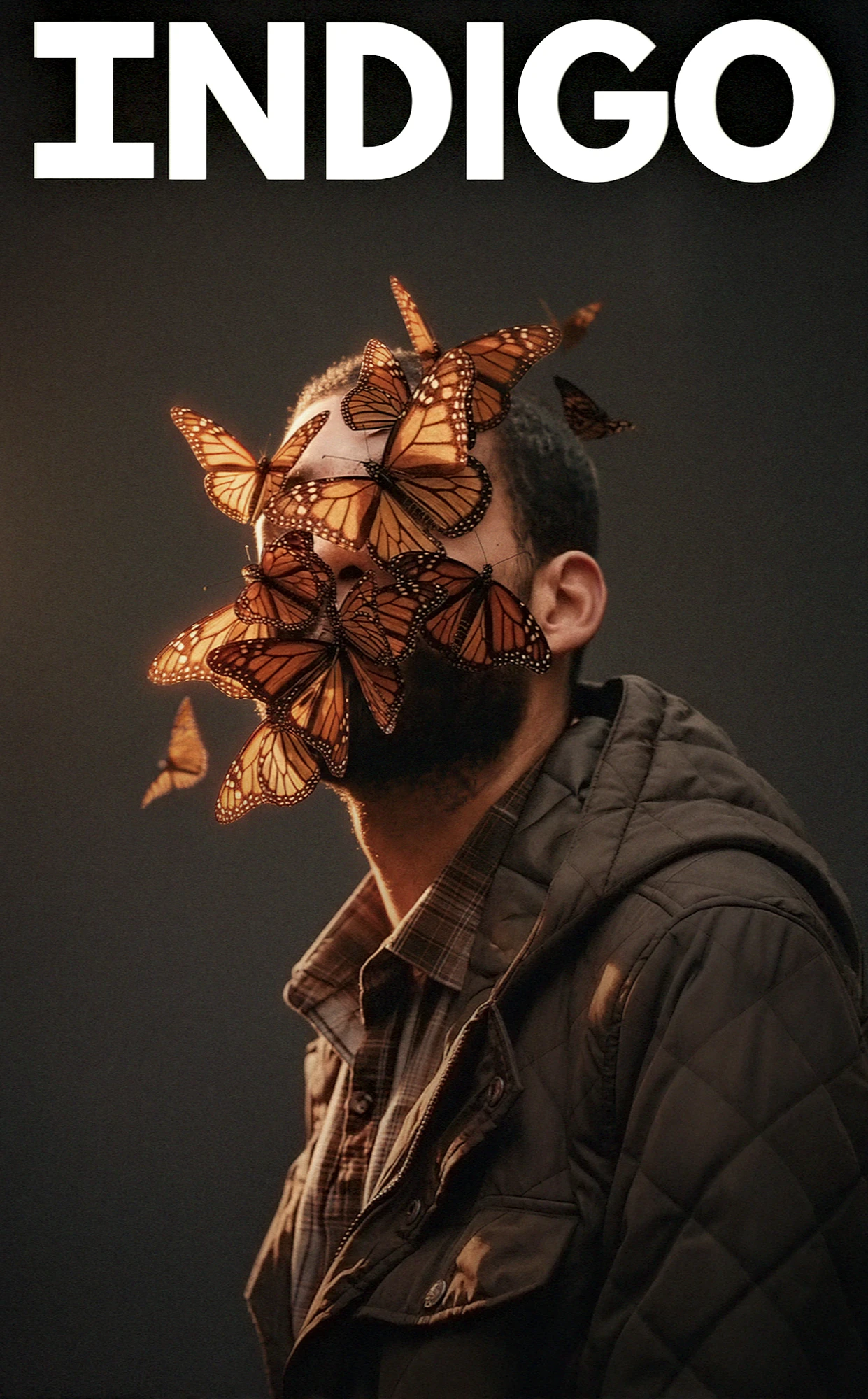
Cover of Volume 01

Volume 01

  1. Sons of Lethe Nicholas Alexander Hayes · 4 min read
  2. The Acclaimed Avian Choir of Western Massachusetts Mary Ellen Shaughan · 1 min read
  3. Ottavo Arma Tenere Samir Atassi · 1 min read
  4. Alibi Claudia Civinini · 12 min read
  5. Lovelorn List Poem J.R. Thelín · 1 min read
  6. Upon the Waters Kyle Owens · 1 min read
  7. When Knowledge Was A Subset Of Belief Heikki Huotari · 1 min read
  8. First Life, Rotting Life Clyde Liffey · 9 min read
  9. Killing Time Liam Patton · 1 min read
  10. Greenhouse Effect Christine Jackson · 1 min read
  11. Impermanence Jonathan Bessette · 15 min read
  12. LOVER Louis Faber · 1 min read
  13. Dressed to Kill Debby Rice · 6 min read
  14. Green Paranoia Marc Darnell · 1 min read
  15. Gummy Bears Jennifer Robbins Mullin · 12 min read
  16. To Stop Up Time Eric C. Smith · 1 min read
  17. Carries seeds Solape Adetutu Adeyemi · 1 min read
  18. Dear Mr. Ross Ellen J. Craft · 1 min read
  19. Bats Brad Rose · 1 min read
  20. A Group Lobotomy William Doreski · 1 min read
  21. Fear Beneath All Fears Jeral Williams · 1 min read
  22. Waterfall Thomas Zimmerman · 1 min read
  23. This Mania Michael Paul Ladanyi · 1 min read
  24. Wound/Scab/Scar Mary Anne Griffiths · 1 min read
  25. Leaving Home Mary Anne Griffiths · 2 min read
  26. Origin Story Marilyn B. Skinner · 1 min read
  27. Fatso Marilyn B. Skinner · 1 min read
  28. Dammit, Petersen Emily Wharton · 1 min read
  29. Buckle Me Tight Catherine A. MacKenzie · 3 min read
  30. Benediction for the Uncertain Susana Gonzales · 1 min read
  31. Golf of Mexico Benny Cauthen · 3 min read
  32. Should’ve Taken Tylenol Liz Gusmano · 1 min read
  33. Bad Taste Howard Moon · 1 min read
  34. What's next for INDIGO? 1 min read

Letter from the Editor

In The Fabric of Civilization, Virginia Postrel details the process in which one creates true indigo. First comes harvesting, then a long and meticulous fermentation. At the first leaking streaks of deep blue-purple, only step one is done; the liquid must still be chemically transformed into a workable pigment. The whole back breaking ordeal of rolling and unrolling the laws of nature is cast aside for the slightest fluctuation in humidity or heat, leaving weeks and months of work precariously clinging to viability. Then suddenly, from the hands of artisans who had nothing more than a pile of rotting leaves a few months ago, wondrously vibrant tapestries spring into being.

One thinks back, to the very first artisans to, by astonishing alchemical genius, generations of trial and error, or pure happenstance, uncovered this miracle of process. One thinks in parallel, to those today staining their skin, stomaching foul odors and shouldering months of intense precision labor to produce true indigo, all while knowing the synthetic factory replica is cheaper and easier to produce. One thinks forward, to those in the future who will continue to go through the process of making indigo, if not for money or ease, then ... for what?

What makes a writer? Neither having a story in mind, nor having a manuscript in hand. Writers emerge from the stormy seas between ideation and finality, where stories leave the comfort of imagination to undergo the ordeal of creation, until finally, they must be thrust into the world, transformed and realized. The messiness, stress and imperfections, the long weeks of refinement and nuanced precision labor - the process - are what makes writing worth doing.

Indigo is about process. We hope you enjoy the results of these writers’ processes; I know I have.

— Kael Knight

Acknowledgments

INDIGO exists because of the writers who trust us with their work, and the readers who trust us with their time. Thank you.

Special thanks to Steven Potter, Melony Watson, and Kodiak Knight.

Cover image: Kael Knight. Editorial board: Kael Knight, Keeley Knight-Bahn.

Set in Cormorant Garamond and League Spartan. Published with Ghost.

Sons of Lethe

Nicholas Alexander Hayes 4 min read

We let our son stay with us but had no desire to bond in the last few weeks of his life. We came into his room rarely just to make sure he was still alive. All night long, his raspy breath filled both floors of suburban home.

He died in bed.

We did not approve of his lifestyle, and his disease which was its consequence. His partner lurked outside our door patiently waiting for us to acknowledge him and invite him in. He rarely spoke to us except to say, “How is he?” We would wave him off. And he would return to sit under a large maple tree in the front yard.

Our son who we remember lovingly had been a fine baseball player in high school. Second base. A handsome figure with tanned and freckled cheeks. His blond hair stood out against the purple cap he would wear that left a permanent indentation in his shaggy mane.

But our son was not ready for his studies. We paid for tutoring but knew he would never be accepted into a good college of divinities. We planned on sending him to a monastery or perhaps worse yet sending him to a philosopher who we would have to send a small stipend to for the rest of our lives so our son could traipse back and forth in a garden or mall-walk while muttering axiomatic phrases. When he disappeared into the desert, we could at least take comfort that although his spiritual awakening would be illusory it would be free. At the time, we appreciated that his partner had convinced him to do this.

But he returned to us: ropey and barefoot. His skin smelled of myrrh, and his breath of hyacinth. The infection from his apotheosis spread so fast that he could not be cured. Boys are always promiscuous, and they had let themselves be penetrated by divine rays. Where he stepped, irises would break through the earth or carpet. He ruined much of our landscaping and décor. We will have to remodel.

He wandered our house for several days not eating despite food being left for him. He would thank us for the offering and place the palm of his hand on our foreheads, curing the arthritis in my wife's hands and the squamous cell clusters on my face. We were offended that he so callously deprived us of our afflictions, our right to suffer, as we aged.

In the last week, he kissed us before going to his room still adorned with baseball trophies. His purple cap hung from a hook at the back of the door. His presence in the room profaned our memories. We tried to get him to stay in the guest room, but by the time he made it the bed he was too exhausted to move. We could not move him as obsidian laced with gold began to spread from a sore on his upper lip. As the mineral slowly replaced his flesh, the floral reek became more powerful. For days, we had to smell the wistful odor of an early summer night as this boy became the incarnation of the setting sun.

When he finally died, there was no funeral per se. We moved his crystalized body into the backyard where he made a lovely addition to our rock garden. We packed his high school keepsakes. We moved box after box into our scrapbooking room. Neither of us would deign to actually pull together something so déclassé, but we enjoy buying the empty books and decorative corners for pictures.

We expected our son’s partner to leave. But he remained motionless in full lotus under our maple tree for three days.

As we packed, I watched our son’s partner from the upstairs window trying to hiding myself behind lace curtains we bought in Europe. The curtains were tatted by three sisters working in a storefront off the canals of Bruges. They would sit smelling the stagnant waters and quietly chatting about the future, the present and the past.

I saw that he was not mourning our son. His partner was merely in attendance. And this was unforgivable. How could he love without mourning?

On the fourth day, we pretended that we did not see him as he crawled over the privacy fence. He stripped his stonewashed jeans and threadbare t-shirt from his body. Ignoring the stone tied with black rope, he walked into the rock garden. He was caked with dirt that creased around his neck. When he rolled over in the sand white grains cling to the curls of his chestnut-colored pubic hair.

The next morning hoisted himself off the ground his body racked with pain. He held the wooden rake as a crutch. Each step seemed to be on glass and as he walked his glutes tensed. He shuffled through the sand demolishing the lines our gardener had raked just a few days previously. He draped himself over our son’s mineralized body.

I rushed to finally confront him. My wife in a large straw sun bonnet and thick dark glasses followed me. He moved his lips as he licked them. They were dry. I wished I had a small white bottle of medicated petroleum jelly to give him. His skin had become like a mortadella of quartz and electrum. Sand clung to the folds of his skin. An injury on his thigh was crystalizing. Geometric formations jutted from his muscles. I placed my T-shirt over his crotch to give him some privacy. But he tossed it off, just wanting to get a few more solar rays and to lie next to our son.

He was not my son, but his presence was the pointed recognition of the absence of my son. As the sun’s light encapsulated him, rendering his body into its final apotheotic state, I pressed my lips to his and inhaled the stale breath that at one point sustained my boy.

My wife rolled her eyes.

Contributor

Nicholas Alexander Hayes

Nicholas Alexander Hayes is a Chicago-based writer and educator. He is the author of Lexicartographies (BlazeVOX) and In Green Carnations (Ethel).

The Acclaimed Avian Choir of Western Massachusetts

Mary Ellen Shaughan 1 min read

High above a snow-
covered field,
six black birds
sit side by side
singing acapella
on the top line
of the G-clef.
Then one of them
takes leave,
flying off with a flourish –
a grace note,
if I’m not mistaken –
its wings trilling
a high soprano
as was inscribed
by one of the greatest
avian composers ever known.
The remaining five birds,
hum-drum quarter notes,
remain in place,
their nodding heads
maintaining the beat,
steady and mundane
as a metronome.

Contributor

Mary Ellen Shaughan

Mary Ellen Shaughan is a native Iowan who now calls Western Massachusetts home. Her poetry has appeared in journals and anthologies both in this country and the UK, and has been nominated for a Pushcart prize. Her first book of poetry, Home Grown, can be found on Amazon and elsewhere.

Ottavo Arma Tenere

Samir Atassi 1 min read

The female octopus declines like Latin. Her death
is a long arm of farewells; ancient, elegant. She loses
more memories than you will have in a lifetime. Her
kind little eye regards you sidewise
from a baggy head, a fleshy computer
powered by three hearts.
She convolutes into a Campbell’s soup
can, or squeezes herself into a glass Coca-
Cola bottle,
so she’s never homeless. She is the sleepy-
eyed stranger in the sea cave, waiting for a guest
with hundreds of cups at the ready. Sometimes,
drawn by distant shore music,
she crawls up onto the land so she can
take in the band, taking care to blend her-
self in with the sand. When trapped
in public, if she could speak, she might say,
“I am the sanest and most alien being
in the room.” If frightened, she shakes out her cloak
of ink in your face, and then shoom,
she funnels away and away
into the dark, back to where the brain
reconsiders its own skin. Her skin
reads you like a mood ring. She tastes you
through her skin. She has tasted your cigarettes.
She is the mind in the mountain that
has known you, but with time
will come to forget you. She shrinks down
inside her senescence, like a hermit
disappearing into her cloak. Towards the end,
she never even knows her thousands
of children. She swims around forever
in the big-headed ocean of lovely for-
getting, the shadow of her hood a pumping spread
into a skinny arrow, shooting across the moon’s
empty head, aimed at a vanishing tomorrow
that will never know
what her arms held.

Contributor

Samir Atassi

Alibi

Claudia Civinini 12 min read

The young woman with the fire torches swirls around the square, her arms hypnotic, her long, luminous hair only ever so slightly teasing the flames.

Next to her, a boy of about fifteen is walking around on his hands, his legs twisting and twirling in the air to a rhythm only he can hear.

A twenty-something with short hair and long legs covered with tattoos hurtles past them on rollerblades, dancing on the speed they generate.

No one gets bumped into, kicked, or burnt.

There are many other artists there, on this square by the ocean, each more enthralling than the other, each more beautiful than the other.

All of them uncannily skilful at avoiding each other.

I place myself there, where no one will notice me. I am in the midst of it all, under this metallic summer sky, remembering my story. I light a cigarette, but I won't burn anyone. My pain won't disrupt the harmony of the beauty woven around me.

My story won't change the world.

It's just for me, and me alone.

#1 Nightscape

That night, I was walking down North Street.

I was going home, the night soft and quiet around me with the sounds muffled to a hush; one foot in front of the other, following the line in the middle of the street, my long skirt brushing my ankles.

I wasn't worried about traffic. The city was all mine.

I was looking for you, and I knew where to find you. Reliably, you jumped out from the second street on the left, going home after a night out. We almost bumped into one another, and I acted surprised.

"Hey!" you said, your voice the right side of tipsy.

Hey, I replied.

You looked stunning, but I didn't tell you. You had on that black shirt that I saw you wearing once, and your hair was scruffy, one lock brushing your face.

I’m going home, I said. Where are you going?

"Going home, too," you said.

I nodded and said I was going that way, you said you were going that way, too. And so we walked away together, and I was shivering, walking by your side.

You looked at the outline of the buildings brushing the stars, and then at your watch. "It's early," you said. "Fancy a drink?"

I nodded, and we went off trying to find somewhere to have a drink, but everything was closed. We tried and tried, and then you noticed how quiet everything was.

"There's no one on the streets," you said.

I know, I said.

I couldn't tell you why, so I just said it was beautiful when the night was so quiet. But I didn't want you to go home, so I suggested the beach – something was bound to be open there, somewhere we could sit down and have a drink. And if not, we could try again another time. You smiled and agreed, and we walked off, and I was shivering so much that you thought I was cold and offered me your jacket. When we got to the beach, no one was there. Not even the moon – it was a starry night, dark and deep. We took a few steps on the pebbles, and that's when you held my hand.

I let you.

And we stood there, looking out in front of us, for a good, interminable minute, before I said: "Do you still want to look for a pub?"

You laughed and you lowered your head as if I had caught you doing something you were not supposed to. You shook your head, and then you looked at me.

"Unless you want to do that."

I shook my head, too. And then I finally found the courage to look at you. With your jacket on I had no excuse anymore for shivering, but I was still shaking like a leaf. I think by then you knew why.

We may have spent an eternity in that position. But at some point, you came closer, and I put my arms around your neck and played with your hair. I remember then the feel of your arms around my back, and you pulling me closer.

It was one of those rare moments for which the concept of mindfulness makes sense: one of those rare moments that are worth being completely present for. Those moments that go too quickly; the moments we end up missing.

Then you kissed me.

Your lips on mine; that's where I draw the line.

I lingered for a moment, and then she called me.

#2 Hellscape

"What's his name again?" she asked.

I shook my head. Had I been daydreaming again?

Yes, she said.

She was gorgeous – a waterfall of waves with an unfathomable abyss in her eyes.

"Are you daydreaming again?" she laughed. "You had those eyes, glazed over and distant. I could see you from the stage."

"I am so sorry," I said.

"Don't be. I would get offended if I didn't know any better. But yours wasn't boredom. You know what I mean – those eyes strained with the effort of looking inside, ignoring the immediacy of the real world," she said. "You were somewhere else. You have the alibi."

She ordered drinks, and an Angelo Azzurro quickly appeared in front of each of us, the cobalt blue of the glass almost fluorescent in the burgundy penumbra of the bar.

"It means elsewhere in Latin, doesn't it?"

"You came prepared," she said, impressed.

"You told me this before. And you also told me about Maladaptive Daydreaming Disorder."

"I did," she said. "I don't think you have it. I just thought it's a fancy name for daydreaming – but what do I know, I am just a singer."

"Why do you think I don't have it?"

"Because it's not just in your mind. You feel things as well, don't you?"

To exemplify what she meant, you came into shot. You had your favourite black T-shirt and your scruffy hair, your skin velvety in the mellow light. I stopped breathing there and then.

"You don't need to breathe, anyway," she said. And then she added, "Look, how does that feel now?"

And I looked at you again. Only you weren't alone anymore. She was there, and you were holding her so tight that I could have thrown my glass at you and it would have bounced back.

The singer was looking at me with studious interest and without the slightest trace of empathy.

"How does that feel?" she asked, again.

How did that feel? My eyes were bubbling lava puddles and my chest had become the end point of the conveyor belt at a knife factory.

I ran off to the bathroom and cried my eyes out in one of the stalls. When it felt safer to come out, I unlocked the door and bolted out towards the bar.

You were there, but this time you were alone. Your hair was in a ponytail and you had a packet of cigarettes in your hands. You smiled at me, that coy smile that messed me up from the first time I met you, and you handed me a cigarette. I followed you like Alice with the white rabbit, only to find myself in the bathroom again.

There I was, standing in front of the mirror, with the gorgeous singer by my side.

"The smoker again, hey?"

I nodded, then I looked at myself in the mirror. My make-up had melted in my tears, leaving my face streaked with perfectly thin black vertical bars. The singer was holding her phone up to me.

"You don't have Maladaptive Daydreaming Disorder. You are lovesick. You have the alibi," she said, looking at me with unspeakable sadness.

"Are you taking a photo?"

"No, I am just scanning your face," she said.

She clicked on something on her phone, and the bar exploded.

We were running away at an unknown speed, deep in the first instants after the explosion, when time stands still.

The singer was holding my hand and dragging me through a cloud of shrapnel, concrete, cocktail glasses, chairs, musical notes, kisses, wise words, tears, and fire torches.

Little bits of the city were scattered above us, waiting to land and crush us.

Then it all stopped.

Everything crashed to the ground in a loud sigh.

The city fell silent again.

The sky was pitch black. We were alone among the rubble.

"What happened?"

"Look," she said.

There you were, holding hands with a bride. "Who?" I heard you say, your voice all carelessness and pity. And you and your bride laughed, your glances burning a hole in my skin as you passed by, disappearing into the darkness.

I ran away, stumbling on the hot ashes on the street.

I lost the singer. I ran until I reached a park, an urban concoction of greenery and graffiti that, for a sweet second, soothed my soul.

I sat on a bench to gather my thoughts, but I couldn't sit still, so I kept running. I passed all the places I knew in the other life – those streets where I would normally go to get a coffee, or see on my morning run, were all in ruins.

North Laine was a smouldering heap of rubble. I ran towards the sea, where the pier was sinking into the waves like its West twin. Shards of wood were stabbing the shoreline, and a flock of flickering lights, chaotic Chinese lanterns, were cluttering the sea and dying slowly one by one.

The beach was deserted. Igloos that used to shelter convivial nights were blown about in the wind, landing upside down on the pebbles. Bits and pieces of torn fabric, perhaps remains of a shredded marquee, were rolling about in the air like confetti. No trace of you, of our imagined connection, of our kiss, could be detected anywhere.

The night spoke only of loss.

I went to look for the singer. The Lanes were drowning in debris and fluctuating string lights. Only one shop was still standing. Inside it, almost everything was crushed and ground. A lonely screen on a wall was flashing, surrounded by spikes of glittering glass. I looked in. On the screen, an image took shape, then vanished, then came back again; it was your face, smiling. As the image stabilised, you looked around the room. Then you saw me.

You turned towards me, your eyes appearing and disappearing from the screen. I sleepwalked into the shop, oblivious to the ceiling brushing my head, to the glass beneath my feet.

When I got to the screen, I looked up. You looked down at me.

For a moment, you stood still and just looked at me. And I looked into your eyes, mesmerized, until I felt like drowning. I gasped for air.

Suddenly, a whole row of screens lit up on my right-hand side. On them, your face was refracted into a thousand faces, all looking at me. Immovable one moment, the next they all laughed in unison while you kept looking at me benignly from the big screen. As all the faces roared with laughter, the room started shaking, throwing blades of glass at me. I ran out of the store just before everything fell down. Your laughter kept echoing through the night as I ran away.

"Leave me alone!" I screamed. "Leave me alone!"

When I got back to North Street, I sat down where I was and cried.

And in that moment, I confess, I felt more alive than ever.

Or if not alive, at least real.

There wasn't anywhere else I’d rather be, but on that raw street, crying.

But the singer reappeared. I heard her footsteps approaching, her hair swinging around her. "It's getting worse," she said. "I am so sorry."

I nodded. It was getting worse.

"The hellscape is getting bigger and better serviced," she said. "I am sorry."

I cried some more, then she took pity on me.

"You need to go," she said. "Now. Get back to your life."

"I'd rather stay here."

She looked at me again with the same unspeakable sadness. "You'd rather stay here. I know. But you shouldn't."

I cried again.

"I can do something for you," she said, in the end. "But it’s the last time."

She peeled off a layer of street, and a staircase appeared. She gestured for me to go. I hugged her, then left.

As I descended, one step after the other, my high-heeled shoes appeared. And then my leggings. And then my dress.

And I found myself at Komedia. The night I realised I love you.

#3 Escape

Once upon a time, I was hiking in Australia. It was a crisp, clear autumn day with a hint of cold in the air. We were walking through a lush rainforest, a kaleidoscope of green, when we saw the ocean shimmer on our right. We rushed towards it and we found ourselves on a sickle-shaped bay with sugary sands melting in the clearest blue I had ever seen.

It was cold enough for us to wear jumpers, but I got out of mine at the speed of light. The cold air hit me all of a sudden, and with it the realisation that I was also scared of the marine life in Australia. It was a borderline irrational phobia. I briefly pondered my concerns – it may be freezing in the water, or maybe I’d be eaten by a shark – and decided I didn’t care: I had to swim in that beauty.

And so I did. I ignored the cold and the fear and lost myself in the view from the water.

That episode came back to me the night I was meant to meet you and my friend at Komedia for a movie. I knew I shouldn't have seen you again. And still, the way I reacted to that dreamy bay is the way I live my life sometimes.

I don't remember much of that night. Just a few brush strokes: the stuff I was wearing; the string lights in North Laine; my rare happiness in the bathroom mirror; and your quiet smile telling me it would all end in tears.

Then, going home alone, I saw us crossing the road, just in front of the Waggon and Horses. You had your arm around my neck and I had mine around your waist. We were laughing. You kissed my head as we crossed the road, burying your face in my hair. I turned and kissed you.

We weren't looking at the road. No need. Who would have run over a couple like that? You know when you are happy, a specific kind of happy, you also feel invincible? That couple who crossed the road had everyone fooled, including me. We could have crossed the road with our eyes closed and it wouldn't have mattered.

The image walked away, blending into the night. And I was alone again.

#4 Seascape

The day after the day the alibi started, I was on the beach just in front of the West Pier. The fog coming from the sea had engulfed everything a few feet from the shore; the waves gently lapping the pebbles were the only tangible proof of the ocean's existence. I was sitting close to the waves, sitting so still that some snoozy baby seagulls had come to sleep around me.

I was letting the sea and the fog soothe me, and the tears were flowing. Sometimes you just have to go and cry your eyes out by the sea, that's one of the truths I live by. And I needed it that day: you know those moments when you realise that the life you lived was not the one you wanted? Of course you know, you are human.

Well, that day, that feeling – which was always humming in the back of my mind's orchestra – came out and decided to do a powerful solo. The trigger? You.

Or, to be fair, the miserable state of chaos I was in after having seen you the night before. I had tried with my whole self to just be friendly, treat you with cool detachment and laugh it all off, but maintaining that I wasn't in love with you would have been ridiculous pettiness. And there was nothing I could do. Nothing I could have done would have changed the state of affairs: I was in love with you, and you probably weren't.

And so I was there on that beach, crying my eyes out, when you saw me. I heard your step on the pebbles coming closer, and I turned to see you, your expression changing from serene to worried as you saw my face.

"What's going on?" you asked.

Suddenly, I couldn't see your face anymore. The fog had eaten you up, and I could only hear your voice, faintly.

"Nothing," I said. "Sometimes you just have to go and cry your eyes out by the sea," I added.

I always had some lines prepared. That was one of the things I would have told you if you had ever spotted me crying by the sea.

#5 Dreamscape

These are not mere reveries. They are the results of a technique that I perfected over the years. Have you ever watched the Black Mirror episode titled “The Entire History of You”? Imagine the alibi as a low-fi version of that. The glazed-over eyes are exactly the same, but the rest is totally different. Instead of a faithful rendition of the past, scrutinisable and zoomable, you have a chaotic rat trap for memories cobbled together with nothing more than longing and desperation.

I am addicted to memories.

I try to recreate those scenarios that are real – for example, the time I bumped into you on my way home – in my mind, and they become a skilfully arranged theatre set. Build it and they will come; it's true: once I built those frames, the memories of you came crashing in.

Your voice, for example. The precise tone and depth of it. It doesn't stay long that clear in my mind before being obfuscated by some other memory. But even that much is enough for a high.

Indulging in the high that those memories bring has a price: the horror that comes when I realise they are just memories, just fiction. That's when the city shreds itself to pieces; that's when I walk in the hellscape. But I’d still stay there, in those strange places where my pain takes me, rather than seeking safety elsewhere. Away from those places, no moment seems to be worth being mindful for.

Be kind to daydreamers – those who miss their bus stops, those who ask you to repeat something you just said. You don't know what hellscape they are walking through. Offer them an Angelo Azzurro, or whatever ethereal globe of euphoria is most appropriate; at least, remind them they are not alone.

Contributor

Claudia Civinini

Claudia Civinini is an Italian-British journalist, writer and editor based in Brighton, UK. While she has a long career in education journalism and has ghostwritten a novel, this is the first short story published under her name. Her passions span a wide spectrum – all the way from literature to chemistry.

Lovelorn List Poem

J.R. Thelín 1 min read

If I wrote you all the words
I think of when I think of you,
I’d have to send you a copy
of Roget’s Thesaurus. Roses. Blooms.
Bluebelles. Baby’s breath. Thesaurus
sounds like a dinosaur. Pterodactyl.
Stegosaurus. T.rex. We saw us
once in a photo booth photo,

a cheap smear of laughter. Our tears
sprouting like the scent of English
roses. A day at the amusement park.
Roller coaster. Tilt-A-Whirl. Shoot-
the-chutes. Our legs wobbled to your car.
Spiked tires. And still we roared.

Contributor

J.R. Thelín

J.R. Thelín's collections of poems include Last Cha Cha in Albuquerque (2017); Breath Into Bone (2010); and four chapbooks: Spin: Tales from the Diamond (2025); Those Last Few Moments of Light: Poems of the Dead Boy (2023); The Way Out West (2005) and Dorrance, Narrative, History (2004).

Upon the Waters

Kyle Owens 1 min read

Welts of sunlight lashed his skin into soresof exploding wounds. A hem of water,indigoed harsh, boiled his flesh intofragmented screams.Can I go with ’em, Mom? Can I?Please? Nothing bad will happen. You’llsee.Wakes rounded in unfolding spheres wallowthe imagination into blunt graves vomitingin their encased souls. A scape uncut frombarks of shore terror the brain into thewash of monsters that swallow up from deepbelow.I’ve never gone fishing for marlin. Can Igo with you, Dad?Melted flesh skims the surface, thawingthe sinews that thread the bones. Breath,over toned with desperation and fire, facedthe inward dews of despair.I don’t think he should go. He’s only tenyears old. Something could go wrong.Prayers become soliloquies to deathto take the hold now. To revenge thespirit of will to storm on beyonddefeat’s black triumph that patternsthe tears which brooks the face.Look at the size of that pole! It weighsmore than the fish does. Can I hold it?Time has drowned. Spasms nettle thered flow that torrents the inner stream.Joys to come lament into screams.You can go, but do as your father says. Idon’t want anything to happen to you.Do you understand?The near mirrors the far. The soulcouncils to downstair the flow anddrink from the poisoned goblet thatcaverns the endless floor.

This will be the greatest day of my life!I hope I get a big one!A knife protrudes from the washbringing horror in cascades of bloodthat gulps the eyes.We’ll be back before six so don’t worryabout us.Rows of teeth to fat the beast goresthe hope into rips of life that slopthe pool.Don’t panic. We’ve got to abandon theboat. We have to stick together.A nudge of bluntness. Skin of grey,bellied white, shims the motionof the recumbent.Dad! Dad! Dad!The sky below. The ground above.It’s night now. Where are they?Oblivion stares.We’ll search for them. Don’t worry.A delicate absence dares the mind.We’ll search again tomorrow.Repetition tents hope.We didn’t find them. There’s no sign ofthem anywhere.Water births life in order to replace themany she has slain.Ashes to ashes. Dust to dust.

Contributor

Kyle Owens

Kyle Owens lives in the Appalachian Mountains, and his stories have appeared in Ahoy Comics, 2228, Roanoke Rambler, among others. His novel 'Red Onion Mountain' was published by Next Chapter Publishing.

When Knowledge Was A Subset Of Belief

Heikki Huotari 1 min read

Ezekiel connected dem dry bones – The Delta Rhythm Boys

Appropriately cloned, with expectations bristling, the solar bolus tumbles from one acid bath into another. It's not what a heaven's for it's what a heaven's not against. If they hate a parade so much or love a vacuum so much they're not natural, they're not neutral. If their heart beats unexpectedly their aim is off and their sweet nothings miss. Their predilections weaponized, the neutral is exclusive or, their preconceptions weaponized, the free will of the perpetrator trumps that of the victim. Ask the innocent civilian what the difference between at ease and attention is. The perfect circle is the enemy of the perfect ellipse. An eyelash for an eyelash and accepting only substitutes, the martyrs got the sins they paid for. A and A are of an ilk. If A and B are of an ilk then B and A are of an ilk. If A and B are of an ilk and B and C are of an ilk then A and C are of an ilk. Clock-watchers of the universe unite! Cast off your causal chains!

Contributor

Heikki Huotari

Heikki Huotari was a conscientious objector to the war in Vietnam, court-martialed for refusing to eat and intravenously force-fed. Since retiring from academia/mathematics they've published more than 500 poems in literary journals, including Pleiades, Florida Review and The Journal, and in six chapbooks and six collections.

First Life, Rotting Life

Clyde Liffey 9 min read

The tumult without – from the storm, the game or news show on TV, the drum machine upstairs – didn’t reflect the tumult within. If anything there was a detumescence within. I opened my eyes, glanced at a brown spider wending along the line where wall meets ceiling. I reached for my drink, not as cool as it was when I poured it, spilled some of it on my hand, the rocker, the glass top of the table I’d put the tumbler on. The book lay open on my lap though not on the page I was on before I started dozing. In my dreams I’m a knight, neither sage nor foolish, just seeking

How I hate this twaddle about seeking. They call them journeys now. How I hate

In my dreams as in life I’m nobody.

I got up, joined Doris in the sitting room. What’s on? I asked.

How’s your book? she answered.

The storm abated, prelude to its recrudescence. Doris lowered the volume on the TV. We both heard Stephan moaning. Maybe you should go up and check on your stepson, Doris said.

In time. I thought he was trying to add a vocal track.

No, he’s scared.

I thought I could train him to deal with adversity much as I hear one can induce an infant to sleep through the night by not feeding it every time it cries. I never lived with an infant. Doris wanted me upstairs. I glanced around the room. She kept the lighting muted. These damn spiders, she said, her chin pointing at the wall.

That’s not a spider, it’s a daddy long-legs, I lied.

Lightning flashed, thunder sounded, Stephan wailed, I was walking to the staircase when the power was cut.

Tamal, said Doris.

Tamal is our cat, a foundling. I paused. What about him?

He didn’t come home.

He’ll be alright.

How can you be so cavalier?

Animals much smaller than cats – squirrels, birds, spiders, mice – survive storms much worse than this every day I thought but didn’t say. Besides not all of them do. I held my tongue and felt for the spiral staircase, the metaphoric if not geographic center of our house. The house, something of a cross between a Cape Cod and a Victorian, sits slantwise on our half acre. Each of the second floor’s two turrets surmounts a bedroom. When I reached the top step, I turned to the right. I could hear Stephan on his bed shaking. I sat near him at a respectful distance. We both saw the headlights of a car speeding along the main road. We live just off it, this town is little more than a few mostly main roads describing an irregular polygon. What is it? I asked.

He was shaking, barely in control. My tapes.

What about them?

They’ll be erased.

They may not be.

They will. Like his mother, Stephan is a pessimist.

I placed a paternal hand on his shoulder. Even if they are erased there may be ways to recover them. I can call in a few favors from a tech friend at work. I thought of my job, of the maps I was expected to produce, wondered if I’d make it there in the morning.

You’re wandering, Stephan said. He wasn’t sniffling.

I’m sorry. It’s been a long day. I was saying

You said one of your quack techie friends could recover my files.

I let his sarcasm go. They aren’t real friends, they’re associates. When I’m away from work I want to stay away, when I’m home I want to be away among my imaginary spiders and toads and yet my mind always returns to work. I couldn’t see Stephan’s face in the dark. There have been artists, I said, who’ve lost all they were working on in fires or storms at sea. Of course, when disaster struck they took side trips to valleys or sloughs of despond but the best of them came out of it. They used the time to rethink their work, to prune away their dead parts. In the end they created work phoenix-like from

You’re mixing metaphors again.

I wished Stephan wasn’t in advanced English. Still, let’s take advantage of the dark, I said. It’s an unexpected opportunity to regenerate.

He seemed to mull this over.

I hooked up with Doris when Stephan was a toddler. After some time away I was just beginning a business career. I’d never been a father, was only intermittently a proper partner. Doris worked weekends to make ends meet. I learned to bathe him, feed him, change him. After a few months I developed a hankering for family life. Stephan and I became a familiar sight at playgrounds, the library, free musical events. Someday I’ll marry Doris, I thought, and still do.

I love you, Dad, he said in the dark, and yet

I know, I parried, and I

I guess it started with the camping trip, he half-snorted, half-sniveled. I can’t blame you or Mom for that. I thought it was something I wanted. Maybe if I had a better sleeping bag, I’d have slept better in the tent, had a proper breakfast

I bought our sleeping bags in the local chain discount store. I could have gone to the respectable sporting goods outfit two towns away but it was our first camping trip, I wasn’t sure Stephan would like it, I couldn’t get him on my insurance, money was still tight. It’s just that, I said,

It’s OK. I’m starting to learn the value of a dollar now. I couldn’t see his expression. What a night

We didn’t properly clear the ground of rocks. We pitched our second-hand tent with minimal help from the scoutmaster. He went off to help inflate air mattresses. I never knew that real campers could use them. It showered intermittently that night. We changed places so that I received most of the water that leaked through the tent. I felt the rocks underneath, heard Stephan’s tossing and turning, felt the rain on my brow. The weather cleared an hour or two before dawn. I dreamed I was in Elver City where I worked. A tall stout young woman with a buzz-cut was telling me about her poems, her admiration for W

A recording played reveille and we were up.

The boys went to the stream to wash. Stephan turned his ankle on a stone, limped down there and back. The fathers kibitzed a while, I felt like a fool with my inadequate equipment, we made pancakes, eggs, sausages on a gas grill. Stephan stood on the outskirts, nibbled a ginger cracker. Is that all you’re going to eat? I asked him.

It’s time to go, he said.

I looked around. The proper fathers were cleaning up. Stephan never ate a big breakfast; I thought little of it. Later Doris quoted me his diary entry:

The effect of that ginger cracker was almost lysergic

That’s preposterous, I told her. What does an eight-year-old know about lysergics?

He wrote it recently, she said, for his Honors English project.

Still

This didn’t seem like the proper time to talk about drugs.

Of course I don’t blame you for the hike, Stephan said, that’s on the evil scoutmaster.

He couldn’t have known.

He had an inkling, more than an inkling.

Our mission for the day was to fold and stow our tents, hike, then return to town no earlier than four so the womenfolk could enjoy their break.

Stephan, despite his limp, was ahead of the others when he discovered the half-eviscerated fawn. I was in the back of the formation marveling at the changeable sky, tripping on the uneven terrain. Of course I ran up to him when I heard his gasp. Until then his only experience of death was the sight of upturned trees we encountered on our rambles through the local nature preserve. How he loved to climb the exposed roots! He was younger then. I held the back of his head as he buried his face in my stomach. The other boys, noting Stephan’s distress, stood behind us and composed themselves. One of them touched the deer’s entrails with a stick.

The scoutmaster surveyed the scene. That’s nature, boys, he declared. It’s not like the movies. The fathers nodded their assent. The boys were puzzled by his allusion.

We’d yet to travel half a mile. Stephan, dejected, limped in the back of the pack while the other boys affected a false bravado. When we returned to the cars, the scoutmaster, who also taught high school music, clapped Stephan on the back and exclaimed, Hope to see you at next month’s jamboree, Claude!

Stephan and I remained close after our only camping trip but something started to claw us apart.

I’ve often thought Stephan’s arrhythmic drumming was his rebuke to the insensitive scoutmaster.

Dad, he said, there’s something I need to tell you.

Shoot, I said, bracing for a drug use confession, wondering about Doris’ whereabouts.

It’s about Susie.

Susie?

The clerk at the general store.

We call it a general store but it’s really an over- or right-sized convenience store. Well lit, part of a national or regional chain, it has few notices tacked onto its bulletin board, sells few or no local products. I sometimes stop there on my way home from work. At the counter anyone can select candy bars or condoms. Susie sometimes eyed me as though she thought we could be an item. She’s a high school senior or already in community college or so I gathered from the books she stacked for when business is slow. She’s too young hence boring for me, I’m almost married, and yet

As Stephan matured, we spent less time together. Part of my earlier single life returned. I tried to remember what that was like. My interactions with Susie

You’re wandering again, Stephan said.

I wasn’t, I dissembled, you’re telling me about Susie.

She’s pregnant, Stephan said.

So that explains her faint glow, meant not for me or not just for me. How do you know? I asked.

I’m the father.

Doris and I can help

Don’t bother, Stephan said. She wants to keep it.

But

She knows about my genes.

A thread, more than a thread less than a thick black cord, of insanity ran through Stephan’s father’s line. Any one of them could flip at any time. Doris told me her husband was charming till Stephan was born. When she returned from the hospital, his crazy gene expressed itself, he took to drink, and was gone soon after.

I couldn’t picture Stephan charming anyone.

She read my diary, Stephan said. She said I was sensitive. The boys in this town are either jocks or ne’er-do-wells. I haven’t done well but I haven’t done poorly either. She sympathized with my struggle, one thing led to another and

Struggle – how I hate

Stephan’s diary unlike his drum patterns was kept in purely physical form in one of those trendy blank notebooks anyone can pay too much for. The brooding entries on death and drugs were in Susie’s house. I wondered what they said about me, what Susie thought of

Now that I’m a father, Stephan said, though this wouldn’t happen for another six months or so, I guess I’ll have to give up some of my dreams. I think that and yet if a drum track is lost

I reached for his shoulder, missed it. Stephan turned away, began gulping air. I’ve already said too much. Mom doesn’t know. Don’t tell her. Go.

I found the staircase in the dark, descended it. Doris was asleep or feigning sleep on the couch. I covered her, found the bathroom, somehow brushed and flossed my teeth in the dark.

That night I dreamed I was powering up our hand crank radio, an overpriced premium from a public radio station. Muscles in the back of my hand twitched. I stopped. The announcer was saying

We don’t have a crank radio. I awoke, muscles on the top of my feet jerked, I turned and saw that sometime during the night our power was restored. The alarm clock displayed a time just after midnight. I fumbled for my watch, noted the time, listened to the pouring rain, peed while calculating my next steps, fell back asleep.

That night I dreamed, I did no such thing, I was as clean inside as out. I rose to pee, I must have dreamed the dream of the hand crank radio. I checked my watch, the alarm, my internal clock was accurate this time, I could show up at work on time or nearly so.

As often happens after storms, the day was sunny.

I heard Stephan in the other room snoring, dreaming his insane dreams of fatherhood.

I padded downstairs, saw Tamal sleeping on the arm of the couch where Doris slept.

I made coffee, turned the radio on, showered. The disk jockey recited the local utility’s statistics, claimed the main roads were fine. Once dressed, I checked on the crawl space, found no damage. I went back in: the house was spider-free or nearly so.

Everyone was still asleep when I pulled out of the driveway. I passed the convenience store on my way to the highway. It was open. It wasn’t Susie’s shift. The roads were clear, traffic was light, a new day was dawning. I hummed discordantly to the tune in my head not knowing what I’d find on my return.

Contributor

Clyde Liffey

Clyde Liffey lives near the water.

Killing Time

Liam Patton 1 min read

1. Alone in the half-light of a day well wasted as it devours a night inadequately squandered.

2. Is it wrong to enjoy the nothingness of a time-blind eternity?3. To know that today is yesterday and that tomorrow has already come?4. To relish in the dread of knowing that the awaited someday is just today with the flavor of yearning and fear?5. Is it wrong to remember that that darkest, most hideous day was just today through a lens of regret and curiosity?

6. That the present is merely a veneer of professionalism over the face of eternal process, made small and simple for the comfort of minds that weep and shout.7. That if I face the fact that my birth and death occur in the same present, that my skin crawls and my heart quickens.

8. Is it wrong to call tomorrow now?9. How wide is the present?10. Am I entitled so to call my minute nibbling of a billion billion years?

11. My mortal, vapid, infinitesimal territory on the infinite landscape of time.

12. Is it wrong to savor the smallness?13. The temporary?14. To enjoy my nothingness in an eternal today and tomorrow and then?15. Must I define my endless living with increments of days?16. Must I mark the lands I wander for others to stomp where I explore?17. Must I relegate the beautiful half-second to the irrelevance of the smallest unit?

18. The briefest instant, twinkling of a lover's eyes in the sunset, made less and worse and weaker in light of the fact that it lasts "only" for an instant.19. I live right now, I die right now, I love and hope and cry right now.20. Is it wrong to live in timeless twilight and dread the insistent question of what time, amputated from the whole without anaesthetic, it happens to be "right now?"

Contributor

Liam Patton

Liam Patton writes a lot. Mostly videogames, fiction, and music, but also quite a bit of non-fiction, philosophy, and theology. He is self-taught. His favorites are worldbuilding, existential horror, ontology, and military theory.

Greenhouse Effect

Christine Jackson 1 min read

Our new house. A bargain. Huge yard
for a garden. We love the attached greenhouse.
Neighbor Mary Ann visits first.

Her red house hides behind clumps
of fiery autumn foliage. Her welcome
casserole is tasty, but Don hates green beans.

I love adding new people, Mary Ann says.
She offers greenhouse advice.
After first snowfall, start seeds.

Cole crops thrive like you’re a plant wizard.
Broccoli, brussels sprouts, cabbage.
Cole crops? My brown thumb never knew.

Mary Ann helps me pore over websites,
order seed catalogs, flats and cell trays,
beds for seedlings. Rich potting soil

like chocolate cake mix. I parcel exact
amounts into each square, gently press
every seed into its soil cushion.

December chills but lush, lemony sunlight
fills the greenhouse, magnifying tiny stem hairs.
Sugar snap peas squirm into my dreams.

Each morning, I water. Moisture seeps into
roots through capillary mats, gifts from
Mary Ann. Zinnias lift frilly skirts.
Marigolds drink gem-like droplets.

In March, woodsmoke from a balky
fireplace clogs my lungs. Doctors
say it’s a stubborn pneumonia.

Stay in the greenhouse, Mary Ann says.
I’ll send help. Sleet rattles the taut plastic
roof. I’m raspy, gasping for air.
No answer from Don at the office.

Mary Ann brings me Heart of Darkness.

I set up a folding chair. Smoke threads up
between pebbles on the greenhouse drain.
I feel a straw-like tendril in my hair.

Green shoots droop. Tender basil leaves
collapse into pungent corruption.
For the first time, I notice the drain’s sluice
holes shaped like demon eyes and fangs.

I turn a page. Tiny antennae poke up
through the drain. Insect eyes bulge
as some creature waits with a stinger,
a green finger of toxic chlorophyll.

Contributor

Christine Jackson

Christine Jackson is retired and still recovering from her day job, professor of literature and creative writing at a South Florida university. She continues to clock in on a life-long night shift writing poetry. Recent work appears in various journals including New Verse News, and Anti Heroin Chic.

Impermanence

Jonathan Bessette 15 min read

ECO WARRIORS, GREENING THE SONORAN DESERT, 20 YEAR PROJECT

Hey, all you eco-warriors looking to fight another day. I’m Finch Cordon and I want my life to mean something.

You might be aware of the work that’s been done by Ties Van der Hoeven who failed to green the Northern Sinai Peninsula or John Liu who successfully re-greened the Loess Plateau in northern China.

Their work has been imitated across the planet to reverse the global temperature currently at 1.95 degrees Celsius as of 2035. I want to collaborate with others on a similar project.

I’m hosting an impromptu discussion group at my apartment in downtown Phoenix, Arizona.

We’ll discuss people’s ideas, how we might work together, and what knowledge and processes we could use over the course of our 20 years together.

I have initial funding, but the main thrust will be about committing our time and energy and personal money to invest in permaculture to turn the land into a food forest which can sustain us (between the 5-10 year mark).

You can check out my website: www.ecowarriordesertrebirth.com.

Or contact me: 555 681 0391

post id: 9819033914 | posted: 30 days ago | updated: 5 minutes ago | craigslist

1

Dust breathes and flows. It spreads like people, like birds, like locusts, like power—each particle a sentinel, amassing and dispersing. The rains no longer come here. Not for decades. And Tyler knows people believe deserts can’t be healed, but he doesn’t care. He scans the pale horizon wanting something more to arise. Their small team of three huddles in the low belly of a pale dune with two blue tents and an orange one.

After two years of massaging the sand with feces and compost, planting bull grass and mesquites, they managed to form a layer that holds water.

In the sandy soil, Jen digs holes for creosote saplings. On the other side of the firepit, Finch sits with legs hanging out of the tent entrance. Shirtless, he distractedly studies the maps and pencils notes on a yellow legal pad: carving terraces into the new dune, constructing retaining walls to increase moisture capture, planting wood for hugelkultur.

While watering the roots of a sapling, Jen remembers her mother’s face, blank with dementia, shouting at her from the hospital bed to never come back. She tells herself this is why she left.

“Water?” Tyler asks.

She pulls back her Panama hat and wipes her forehead with a blue paisley kerchief before sipping from the ladle.

Finch keeps glancing up from the topological map, scratching his scruffy chin, but also just staring. He’s a starer and it makes Tyler and Jen uncomfortable. The mantra flows out, but no one can hear him mumble, rhizosphere, groundcover, herbaceous layer, shrub layer, understory, canopy, verticals. He sleeps with all the seeds he can’t wait to germinate in the fifth year as if girlfriends.


At lunch, Finch organizes sandwiches on a makeshift cutting board with handfuls of foraged salal to zest the salami and rye. Tyler chews loudly and mentions how he hates shipping in food on the solar truck they sometimes run a few miles into town.

No one says anything for another hour until Jen murmurs it’s time to take soil readings, and someone needs to go check up on the previous dunes where they’ve established pioneer landscapes.


By nightfall, everyone wants to watch the fire burn. The few pieces of imported pine from Canada, brought in during the last visit to the nearest town, crackle with laughter.

Tyler slurps at his hot chocolate with bourbon. Signing up for this program had been one of his rebellions against his Trump-supporting libertarian father. Instead of taking over the investment firm, he would live in the desert for twenty years bringing something back to life.

Jen glances at Tyler in the watery glow of firelight and wonders if he’s still having nightmares about his parents—he talks less these days. The landscape strips away the need for their voices.


Another Tuesday comes—but all days feel like sand falling through an unremarkable aperture: they bury the lengths of pinon pine on the new terraces, creating pockets for moisture and runoff.

*

Wednesday, they drive in water and lumber from the nearest town. Friday, they dance to Duran Duran from Tyler’s solar boombox under a full moon serenading the new rows of young ironwood.


Monday, everyone starts again somewhere in their cycle. Each trusts the other. The other is the other. The plants breathe. The flakes of calcium carbonate and clay form new aggregates with the new dirt and detritus. Lines are drawn which connect and delineate simultaneously.

One morning, Tyler hums a song Jen can’t name—a high school dance; driving to the airport with Mom before Thailand; her first kiss.

“What is that?”

“I Love You Always Forever.”


Friday. A desert storm destroys several patches across all four dunes where they’ve established pioneer landscapes. They replant what they can, chop up the rest, bury or huddle the mulch around tree trunks. Finch watches them comb the last sections torn up by harsh winds and sandblasts. He knows most greening colonies like theirs have little success.

2

A year later, a high school class shows up under the grey and yellow morning sky. The math teacher, Mr. Gelstein, heard about them through social media channels, hired a bus, planned the most direct route using old maps which show the roads now obscured by the Aeolian processes.

He tries to explain while huffing at the edge of camp,

“Students should understand how science manifests in soil and see the importance of greening a desert.”

Jen waves at some of the kids to follow.

A group of boys surrounds Tyler who shares handfuls of desert chia and wolfberry. He explains how these deserts used to be lush and full of saguaro and prickly pear.

Jen watches Tyler from the top of a dune, his hands on his hips, clearly annoyed. She’s wondering if his nightmares of his father still keep him from sleeping.

“Miss Lewis.” A girl with pigtails faces Jen. “Do you think we can turn back Climate Change?”

Despite the fact that Jen will sacrifice almost twenty prime years of life, she doesn’t believe they can stop the runaway systems. She tries to hide her real answer behind a practiced explanation: the scalability of carbon capture technology; the reinforcement of carbon-dense soil systems; and new market technologies helping global industry adopt low carbon neutrality.

That night, they drink more bourbon than hot chocolate. Tyler goes to say something and stops. Back in the dark of the tents, Finch muffles his mouth and cries himself to sleep, hoping no one can hear. The sobbing wakes Jen. She puts an entry in her journal where she tracks all they do: back in Seattle when I was an office admin for Greenpeace, I used to tell myself, “The planet won’t die, it’s seen many mass extinctions, life will go on.” But I now know greenhouse gases could wipe out all possibilities of life. We could turn Earth into Venus.

3

Year five; year of the monkey. In cheap paper party hats, wheezing on kazoos made from bamboo, they sing “Auld Lang Syne.” Finch can’t believe they’ve made it this far. Jen asks him to stop repeating himself. The repetitions trigger a memory of her mother asking who she is, why she’s there, who she is, who she is.

At the crest of a dune recently planted with ironwood, they stumble drunkenly. Jen looks back at the trail they’ve left behind. They’ve finally managed to create small ponds that persist for a few hours before the sun rises.

Tomorrow, they’re going to start the chop and drop for the succession of many of the pioneer landscapes to make the leap in soil development. Tyler thinks of his dad—a conversation they’d had once about disaster capitalism, how he’d made a huge move of assets into Florida after the great hurricane of’ 32, making hand-over-fist profits from government-backed support, using cheap undocumented labour to build shoddy buildings that just made it past code. This was the last straw before Tyler disappeared without a word.


The following Wednesday, Finch shaves. The massive clumps of black and grey form a mound on his blue sleeping bag. The smooth skin feels as if he’s removed sorrow and memory, data hanging from his chin. The recurring dreams of angels, where they speak to him about the Garden of Eden, convince him their work builds a reality into the unseen.

Under the stratus clouds, they hack limbs, kicking the wiry curls apart so their decomposition spreads equally. They work for eight hours straight, only stopping to drink from the galvanized tub with ladles, relishing the water they’ve partially co-created.

4

On a hot Tuesday in the year seven of their lord, they all work on a high ridge planting ironwood. Something glimmers on the crest over a few dunes. Tyler waves, thinking someone is walking toward them, but it’s just a bent ironwood warped by the heat haze.

That night at the fireside, Tyler tells a scary story that’s actually kind of scary, about a ghost sitting at the base of people’s beds every night, never changing position, there from midnight to dawn, only disappearing after the person goes insane.

Another uncommon windstorm sweeps the area while they sleep.

In the morning, they crawl out of their tents early, anxious to see the destruction. They feel an uncanny sense of ease because most of the plants remain rooted.


The next weekend, while they forage mesquite and ironwood pods from the first dune landscape, Jen notices the heavy whir of a diesel motor on the wind.

“Do you hear that?”

They go back to camp.

A large truck, with a gleaming smile of a grille, rattles over a ridge into the sunlight, its bright blue body bristling. Sand spurts all around the large black tires grasping for traction. The truck slows. Clanking doors whinge open. Two blue-jean-wearing men hop down with their unkempt beards and baseball caps, their white t-shirts.

“Who’s the one who talked to my son about all that carbon capture bullshit?”

“Oh?” Tyler smiles. “The students from years ago?”

One man looks like a capital I and the other like a lowercase i.

Finch tries to ask for their names, and the one who’s been speaking keeps speaking but doesn’t share his name until Finch repeats the question uncomfortably a third time.

“We’re former cattle ranchers,” Sid says after introducing himself.

“Ranchers, huh,” Jen considers, “Did the global turn toward crickets effect your business?”

Wind blows through them, pillars of flesh, dry and hot, standing a few feet from each other, holding up nothing. Benny, the tall one, cracks his knuckles:

“What you’re doing don’t make any sense, it’s confusing, offensive. My wife divorced me and became one of you eco-freaks.” He leaps from point to point as if a rehearsed argument he's been playing out over and over again in his head. “That’s your fault.”

The two men turn away, confer for a minute, their voices hiding between the branches of a mesquite tree. When they’ve rallied, they point their fingers to the top of a dune outlined by the shade in the hard light of afternoon.

"We wanna see what you’ve done, show us what you’ve accomplished,” Sid prods.

Six people trudge up between the swirls of creosote bush and young ironwood and Tyler shouts, “Stop! Wait! Why’re you really here?” He approaches them with his hands raised high and his voice billowing out like the fat belly of a sailboat spinnaker, the kind from boating trips on the Connecticut coast in summer—the only time he remembers laughing with his dad after his mom died. “You’re going to come up here with your Malthusian fucking ignorance, don’t you understand everyone in the world could live in Texas with 800 square feet, about how two-thirds of all produced food goes to waste before reaching a mouth, about the lies used to construct abundance and scarcity rollercoasters?”

This is the argument he’s been waiting for all his life. These two men speak like his dad, and that’s fine, because he knows it's weird and all the competing voices in his head hate them, but he still wants them to understand. And when he says,

“You don’t deserve to just come out here and make me feel bad for choosing this. I didn’t cause your divorce. I didn’t ruin your lives.”

Sid starts to cry.

His weak shuddering disarms Tyler who lowers his hands and says, “I’m sorry.”

“Sid’s parents killed themselves after the ranch went under.”

“We grew up together, farming and ranching,” Sid blubbers, “Then watched the agro-firms buy up all our land, and all the foreign workers living in shipping containers, being paid in pesos made it impossible to compete.”

“It’s people like you who fought to eat fucking crickets.”

“Looks like we’re going to have a storm tonight. Stay with us for a bit longer,” Tyler offers.

“Why not give them time to talk more.” Sid pats his friend on the shoulder, wipes his nose. “Hear all their reasons?”

The crackling of the storm and the loud winds stir up the land like a white sheet on a clothesline. Benny tries to focus on all the information they share about permaculture. Their tents don’t have much in them, their truck isn’t well-equipped. The water they collect daily, how much food they forage, how it’s processed and stored—it’s all a struggle. Sid and Benny grin enthusiastically. This rugged living they can understand.

“So,” Benny says, “What else do you do here?”

5

Year 10. Sid repeats the mantra under his breath, rhizosphere, groundcover, herbaceous layer, shrub layer, understory, canopy, verticals. The rhythm reassures him. It enmeshes him with the land. The others.

The night of his conversion, around the fire, Finch embedded the names of the seven layers of a permaculture forest in him. But first, it’s his speech about the Amazonian rainforest being an artifact—how ancient Indigenous peoples planted and replanted certain species, creating its endless array of medicine, food, and resources. It’s the Garry Oak Savannahs of the Pacific Northwest, that settlers believed to be the Elysian Fields of Greek Mythology—which they foraged until all the chocolate lily, camus, and Garry oak went extinct. It’s the giant sequoias and red cedars of California—how shells were brought in from the coast to feed them more nutrients; their trunks intentionally scorched to produce a protective response, allowing the trees to broaden their base to support massive heights. Humans built the nature that 400 years of industrialism had destroyed—a kind of lost grandeur, greater than any fossil or artifact they would ever dig out of the ground.

Sid grinds mesquite pods into flour with the mortar and pestle. Blurry bipetal dots along the dunes distribute captured water to drier areas. They take readings of soil moisture, groundwater, micro-bacterial and fungal biodiversity.

Something about the cold evening winds, the clouds hanging at the periphery of the Precambrian mountains makes Sid nostalgic for childhood on his parents' old farmland in northern Arizona. He’s become so close to the land that he knows the flavours of different soil mixtures, the humidities of seasonal winds. He wishes he could tell everyone back home how this ancient ecology of mimicking nature could transform lifeless sand into a jungle.

“You okay?”

Jen kneels in the brush putting down her watering jug. He smiles pointedly at her and says yes. He came from farmers, from ranchers. He came from people who built the food of the old world. Now, on his diet of mesquite or ironwood tortillas with prickly pear salsas and sow thistle greens, pine-nut butter and juniper yam soups and fried yucca, his bony wrists are sharp enough to cut glass.

They’ve started weaving new clothing out of beargrass. Sid’s joints itch from the unprocessed twine. But he’s never been this happy, or so he says to Jen. She nods and eats a handful of pine nuts, offering him some.

They all worry about Sid but appreciate his presence. His extreme pivot in life reads like Tyler’s reactionary decision to join. And it took Tyler at least two years to smooth out those rough edges of opinionated judgment and self-righteousness.


Later that week Sid wakes up shaking. He’s drawn into the darkness under stars and a new moon. Is he dreaming? After only about ten minutes Sid bypasses the green region into the loose sand where nothing grows.

Within an hour, Sid’s lost, but the mountains aren’t that far away. Maybe he’s moving in circles? Maybe he’ll never find his way back? But the sun’s not up.

Morning light spills sideways over the molars of mountain rock that skirt the edges of the desert in all directions. At the bottom of a small dune, two sticks tied into a cross stand vertically out of the ground. Treasure? A body?

He digs but the sand keeps finding its way back into the hole. Sid’s sweating and exposed. At hip depth, he’s found nothing. An empty marker meant for a passing stranger, that whispers there is a grave waiting for everyone. And he remembers a vacation on the East Coast, when his aunt brought him to the North Carolina Museum of Natural Sciences. It’s the two dueling dinosaurs on display, frozen forever in an architecture of death, that breaks him. Because the dust doesn’t forget. Because trying to reverse climate change, rebuild a “nature” that was indifferent to him, was horrifying.

Blistered and dehydrated, Sid somehow makes it back to camp. Even without a body buried at the location, they all agree someone should drive to the nearest towns to ask if anyone’s missing.


A week later, Sid isn’t in Jen’s spare tent he’d been using. They don’t find him when they search the area calling his name. Maybe he just walked out? Jen murmurs she’ll miss him, and that’s the last thing anyone says for a month.

6

Every week during the 14th year, they gather the foraged foods of dozens of plant and tree varieties and drive to the nearest Sunday farmer’s market. The folks who wander over always ask questions about the gnarled glasswort, the ruby prickly pear, the paper bags full of grey mesquite flour or the pine nuts; but people recognize the brined olives and ask, do those grow here? Finch always chuckles to himself before going into a speech, “What can’t we grow here!”

Although their nameless farmstand sells a few products here and there, it’s hard for others to see them as anything but a cult. Their undyed beargrass shifts and shirts and skirts replaced the old tattered polyethylene/nylon fabrics of their outdoor clothing. They look like some sect of Mennonites.

Tyler flirts with a nature-goth girl wearing patchwork jeans and a black fringed jacket. Jen goes to look at the other stands. As she picks over some potatoes to bring back to camp She remembers the day they went to visit the Tohono Oʼodham Nation to talk about the site they wanted to live on and green.

A few council members had taken them seriously enough to meet. They stared at them in the office of their council building, baffled after the proposal, and one said, “You want to pay us rent to live in our desert for twenty years, in order to try and repair the damages caused by your people, and return it to a healthy biodiverse region, and then leave?” An uncomfortable quiet lasted two whole minutes before one of the elders said, “We’d just need to kill off ninety percent of your families and I think we’d be square.” Finch audibly choked on the dry air before one of the other members started laughing, followed by more. Jen, Tyler, and Finch joined with timid smiles before conversations about drawing up a contract began.

Finch is alone at the market table. He glances up occasionally to see Tyler with the girl, Jen filling up a burlap sack. He smiles at a customer from another table who looks interested but turns away at his grin. A young blond man wears a fashionable leather jacket. The strong hawkish nose and big pink lips, those sandy eyebrows and pale blue eyes.

“Is that you, Sid?”

Sid acts casually, an “Oh hey, how’s it going,” moseying over with his taupe tote bag on one shoulder, a few frowzy bits of celery hanging out the top. Finch tries to get questions through his teeth but can’t manage. Sid apologizes, once, twice, he even blushes as he asks how everyone’s doing. Finally, the full sentence makes its way to completion, “Why did you leave?”

Sid sighs because he knows how hard it’s going to be for Finch to hear his answer. Because he knows how sensitive Finch feels about the entire program of greening deserts. And he doesn’t ever want to think again about that grave.

“I realized what we were doing was irrelevant and it got boring,” Sid lies with a shrug that can’t confront himself. “I kept having this Bible verse repeating in my head the days before I disappeared, ‘Eat, drink, and be merry, for tomorrow we die,’ and I realized I was already dead out there.”

Finch hears this phrase which becomes an earworm, mixing this new revelation with his rhizosphere, groundcover, herbaceous layer, shrub layer, understory, canopy, verticals. Boring.

Tyler returns from the washroom to find Finch nearly catatonic. It takes ten minutes for him to get an explanation. Jen brings a handful of golden plums she bought with some of their leftover earnings and drops them at the sight of Finch. They pack everything onto the transport truck and start the drive home.

Tyler chews a hangnail. Mumbles of inflected agreement rumble like the clouds on the horizon. Another June storm rolling through—a once common thing, gone rare due to climate change, now returning. They don’t think anything of it, going to bed a bit more defeated than they’d ever been in the last fourteen years.


Intense rainfall wakes Tyler, something feels wrong. He opens his tent, sees Jen unzip her nylon door covered in duct tape patches. A flashbulb of lightning captures their slack faces, wide eyes. The rush of water is so loud it can only be a flash flood heralding the return of the long-lost spring rains of the Sonoran. This is what they had worked to accomplish.

Jen’s body is paralyzed—a flood of memory from the whole of the Earth, and she thinks back to the song she sang with her mother on the way to the airport.

Finch wakes up to shouting. He recognizes the fateful word of death hanging on the wind, and wonders if they’ll be remembered, martyrs somewhere carved into stones and left like pillars for the future.

Tyler’s bare feet throb from the stab of twigs and hard stems as he flees, wishing he could talk to his dad again, to his mom.

By the time they’re all running, their neon tents are brushed away like birthday balloons on a draft of wind. Bodies tangled together, lost in the sandy melange.


When the sun rises, the light cannot find the three bodies buried beyond its reach. But the still-rooted plants dry off, their limber joints stiffen and stretch. The grass and scrub-bushes bristle in the light, somehow greener.

A gilded flicker swoops over and claws into a young saguaro. She watches grasshoppers springboard around the dark soil, while a grey cactus mouse leaps and slips into a little divot preparing to strike. He grabs a desert clicker, gnawing the chitin tube from one end to the other. The mouse stiffens to alert as if being watched. A cold and eternal breeze full of unfamiliar mixtures of mud and debris streams across the newborn hills under clear, blue sky.
Contributor

Jonathan Bessette

Jonathan Bessette has many practices which influence his writing, including astrology, permaculture, and anarchism. He lives in the unceded and traditional territories of the Musqueam, Tsleil-Waututh, and Squamish Nations—so-called Vancouver. He has published in The Capilano Review, CV2, Adbusters, The Antigonish Review, and Carte Blanche.

LOVER

Louis Faber 1 min read

There is a moment
just after, when the ticking
of the clock on the nightstand
is amplified, reverberating
off the skylights, when
the heat of your body is
a blanket from which
I never wish to emerge.

Contributor

Louis Faber

Louis Faber's work has appeared in The MacGuffin, Cantos, The Poet (U.K.), Alchemy Spoon (U.K), Dreich (Scotland), Prosetrics, Passager, Atlanta Review, Glimpse, Rattle, Pearl, The South Carolina Review and Worcester Review, among others, and was twice nominated for both The Best of the Net and the Pushcart Prize.

Dressed to Kill

Debby Rice 6 min read

This store treats clothing with respect. The dresses rest on padded hangers. With only three or four to a rack, they have space to breathe. The salespeople handle them gently, never allowing a dress to be slung over a chair, tossed on the floor, or, worst of all, to dangle from a hook. Here, wrinkles are smoothed with a gentle whoosh of steam, loose threads are carefully snipped, and buttons are securely fastened. Yes, it makes things difficult, but that only adds to my satisfaction.

Dresses are so much more than fabric and design. They are beguiling parasites-- personalities without souls. Sliding over our hips, they seduce us into thinking that we wear them. When, of course, it is the other way around.

I walk the aisles slowly. As I pass from one mirror to the next, my reflection becomes a stranger. I see a tall, angular woman in a black cashmere coat, a person more compelling than pretty. Her hair shines like a smooth, gold cap. It swings back and forth across her shoulders. But her nose is thin and her mouth ungenerous. Bangs hide the high forehead, directing attention to the eyes, the aching blue of Arctic ice.

This is a person with acquaintances, not friends — a woman who doesn’t chat with cab drivers or seatmates on airplanes, someone who would never say “have a nice day.” She lives outside the boundaries. Like the dresses she covets, she is pure style. Feelings were not included in her design. She finds emotions both tiresome and petty. Yet, she is not without her particular passions, and there is nothing she enjoys more than a dangerous game, an unpredictable afternoon.

I run my hand along a marble counter. My mind goes blank. I stop thinking and observe. The store is a stage, and I am waiting for the plot to unfold. Designer Dresses is quiet but not empty. There are two salespeople on the floor. The rest are at lunch. One stands at the cash register. She has filled several garment bags that hang on a trolley beside her. Now she is folding sweaters. She does this carelessly, without smoothing the creases. It is a big sale. She should be excited. Instead, tired or bored, she works in slow motion. Her glasses slide down her nose. Each time she stops to push them up, her customer, a tall redhead in a camel coat, becomes more impatient. She combs her fingers through her hair. She shifts her weight from one foot to the other and grinds a stiletto heel into the carpeting. She checks her watch and adjusts the shiny black bag on her shoulder. The display is as useless as a peacock performing for a goldfish. The saleswoman looks right through her.

The other clerk I’ve seen before. She’s big, maybe six feet tall, with a Central European accent. Pushy and loud, she knows how to sell clothes. Today, she is hustling-- taking advantage of the lunch hour to wait on as many people as possible. She is in and out of the fitting rooms, striding back and forth, a clutch of hangers in each hand, head lifted, back straight as a dancer’s. Her skirt swishes, and her nostrils flare as she walks past a promising customer. Her nose for money will make this a challenge. But, for now, I am invisible. Disappearing is as easy as ice skating or riding a bike. I can become a distraction in of the corner of your eye, a shadow without substance or weight.

As I walk in slow motion, each step articulated, my eye fixes on a spot of red. Crimson stops me in my tracks. This is not the happy color of roses or Christmas. It is the red of wine or blood, a serious shade that matches the weight of the velvet fabric. I walk to the rack and remove the hanger. The dress drapes softly over my arm.

I move towards the fitting room. The door snaps shut. I take off my coat, my boots, my slacks, and blouse. I raise my arms, and the dress slides over my shoulders. The silk lining washes down my arms. It flows like water across my ribs, my belly, and down my hips. I reach behind for the zipper and pull. The dress encloses me. Turning to face the mirror, I am completely present. My breath is slow and deep. My heart, for a moment, stops. I admire my breasts, my neck, and the shadow in the hollow of my throat. The waist is cinched tight. The skirt is so narrow that it needs a high slash up the back to walk. I turn and look at myself from the rear, liking the way the skirt tapers just above the knee and the contrast between skin and fabric. This dress is much too good for some simpering debutante to wear at a charity gala. It is a sophisticated garment meant for a serious occasion.

But I’ve wasted too much time already. Hangers clatter against the fitting room door. Out of my bag come the scissors.

“Everything ok? Is there anything I can bring you?” asks the go-getter.

“Nothing right now,” I sing back.

“That is a beautiful dress. Have you got it on? I’d love to see. I haven’t seen it on anyone yet. Can you come out?”

I wonder if she fakes that accent. She sounds like a bad actress in a vampire movie. All the same, my heart beats faster, and my hands tingle. She has seen me with the dress. This makes a more interesting challenge.

“Sorry, I just took it off. I think it’s too small.”

“Can I get you a larger size? We might have one.” She has no idea how this interference excites me.

“Ok.” I decide to take her bait. I hear her walking out of the dressing area. I start to work again, cutting gently around the sensor. The scissors are razor sharp, and the fabric parts easily. No one could do this more carefully, but each time the blade bites cloth, my stomach tightens. The damage will be on the inside of the dress. It can be mended. But I am remorseful for causing this injury.

Finally, the plastic tag comes loose and drops to the floor. Picking it up, I move to the corner of the stall. I make a slit in the carpeting. Working quickly, I dab a bit of glue on the sensor, put it under the carpet flap, and push the flap back into place. Now, the dress comes off. The material folds easily into a neat square packet and fits into my bag, along with the hanger. Standing half-naked in front of the mirror, I feel stripped and empty. But there is no time for melancholy. Ms. Romania knows exactly which dress was in this room; the trick will be to make an invisible exit.

A smart little rap on the door. “You’re in luck. I have it in the next size,” she chirps.

I open the door a crack and stick my arm out. Ignoring my hand, she pushes her body into the opening. Such boldness is never a good idea.

“I can take the other dress out now. Give you a little more room.”

Her tone stops just short of being a command.

“I’ll need to keep it here to compare. I’m really not sure which size is right.”

With my back turned toward her, I put my arm out the door again. This is an ungraceful and suspicious pose. But without admitting that she thinks I’m up to something, she has no choice other than to hand me the larger dress.

“Why don’t you try them both on and let me have a look?”

This is really more than I can bear. She is both tantalizing and annoying.

I open the door to the cubicle wide. “Please do come in, I could use a second opinion,” I say, flashing my best sorority sister smile. And in she comes, suspicious yet innocent. She doesn’t have the imagination to realize what might be in store, and, given the circumstances, I can’t say I blame her. This recklessness is beyond my usual style.

Her eyes narrow and sweep the room, then give me the once-over. She takes in the way I’ve hung my clothes neatly over the chair, my pearl necklace, my Italian bag and shoes, the pink silk bra and panties, everything just as it should be in Designer Dresses. I watch the muscles in her face slowly relax and settle into an expectant, money-grubbing grin. Her body morphs from rigid to obsequious. She’s ready for the next easy sale. She unzips the dress and removes it from the hanger. Although she holds the sleeves carefully between her thumb and index finger, I cringe watching her touch the fabric. I step into the dress, and she stands behind me and zips.

“Beautiful, simply beautiful. But I think it may be a little big. See how it bunches just here,” she says, pulling the dress tighter around my waist. She is standing behind me. We stare at our reflection in the mirror. I am motionless, waiting for her to make the next move. The dress no longer matters. She has captured my undivided attention: too-red lipstick smeared on her teeth, black hair showing a millimeter of gray roots, and a faint makeup line at the chin. Like a good hunter, in a split second, I have fixed her in my sights.

“We could alter it. But let’s see how the other one looks,” she says turning away. Where is it?”

She is impatient to bring this to a conclusion, and so am I.

“Oh, it’s just there under my clothes on the chair,” I reply.

She bends over and picks up my pants and coat. “I don’t see anything.” I hear the wariness again in her voice. She starts to straighten up. As she does, I reach quickly into my bag. The scissors are right on top, just where they should be. It’s done in a minute. She has no time to struggle or even think. My aim is perfect. The blade lands between her shoulders just to the left of her spine. There is a sound like the air rushing out of a balloon as she collapses to the floor.

I step out of the dress and hang it gently back on its hanger. Really, she was right. The one in my bag is the better fit.

Contributor

Debby Rice

Debby Rice is a Chicago writer. Her business, When Words Matter, serves nonprofit clients. Debby creates fiction with attitude—unsettling, vivid, and crafted to entertain. She is the author of two novels. 'Chihuahua Karma' is available on Amazon, and 'Friending the Devil' is serialized on Substack.

Green Paranoia

Marc Darnell 1 min read

I hear my plants whisper before I
fall to sleep– wet and wormy words
like cabbage, intestine, brood, betray.
I give them blue, red and violet light
without thanks, and they only show
their waxiness when they want food
or tilt into nemesis sunlight. They are
the house cats of the botanical world–
ungrateful but helpless on their own.

Sometimes in the morning from my
bed I'm sure they hold each other's
leaves like hands, wishing their roots
could bind together in conspiracy or
their stems make love. Some vine
down as if I don't see them, snagging
into the carpet, while others darken
the room’s corners like an anti-Eden--
defiance to me their mammalian maker.

Contributor

Marc Darnell

Marc Darnell is an online tutor and lead custodial foreman in Omaha NE. His recent books are Forecast: Increasing Visibility (Kelsay Books 2024) and The Mining Muse (Impspired Books 2024). He has 3 times been awarded an Academy of American Poets prize. His latest book is And The World Doesn't Know It Is Weeping (Kelsay Books 2026).

Gummy Bears

Jennifer Robbins Mullin 12 min read

She was on the phone, on speaker, so he could listen in. He was so small, like a swollen thumb (He was in actuality a type of beetle, an invasive species, nonnative, alienus, in larval form.) with bristled, highly reactive hairs sprinkled over his milky translucent body. He smiled a lot. It split his face like a carved pumpkin, and then you could get a glimpse of his authentic self held deep, deep, within. He’d laugh and point at nothing with his diminutive thoracic legs, all six of them. She’d laugh too, but not right now. This was serious business; they were On The Phone.

“Hello,” she uttered barely above a whisper, and then she covered her mouth with her hand, afraid of other words disgorging.

“Ursa? Hello? Are you there?” The voice on the other end seemed so loud. The grub covered his hearing sensors with its forelegs.

“I thought you called me.” Ursa held the phone between two fingers like a hot pop tart and leaned in when she spoke.

“I did call you. Just now. What’s going on? Are you coming over for dinner? Where’s Griffin?”

(Unintelligible chattering)

“Hello? Ursa?”

“Yes, yes, yes. …We’re not coming, I’m so sorry. I think I have vertigo. Can you imagine? I vomited!”

“Where’s Griffin? Did he come into town or is he still in Indiana?”

“He’s right here. He’s taking care of me. (Unintelligible chattering) Oh no, wait, what? No, he’s not here. He is not here with me at all.”

“Are you ok? Should we come over? You sound so strange.”

“I’m so sorry, I’m just so sorry.” And Ursa severed the connection. Unsure of what to do with the phone, she placed it underneath a pillow, and then pushed the pillow down on it HARD. Griffin wanted her to flush it down the toilet, but that seemed like a lot of effort.

The blinds were drawn in the bedroom and the thermostat was cranked up. A humidifier pumped moisture into the room. It was oppressive. Depressive. Ursa went to switch on the lamp on the bedside table and Griffin chattered madly until she withdrew her hand. He squiggled up onto her shoulder and communicated at length into her ear, nipping at her earlobe and injecting her with a neurotoxin. She laid back on the bed, a woman in staged repose. He maneuvered down her torso. There was a sharp piercing sensation on her left breast that only hurt for an instant, and then she felt nothing, and then she experienced a very vivid waking dream.

Giant insects with iridescent wings glided effortlessly across the sky, challenging the atmospheric tension, creating visible ripples in their wake, and she came to realize that she was looking down at a pool of water and not up into the heavens. Some of the mirrored clouds weren’t clouds at all but fish moving below, white scaled bottom feeders whose mouths never ceased their reflexive sucking. She squatted down to get a better look at what was real and what was a reflection.

As if shoved by an elder sibling, Ursa tumbled head first into the pool and then somersaulted out onto a rug into a room with no windows. She stood up and looked around. There were frames on the walls, dozens and dozens of frames, of every size and shape, mounted from floor to ceiling. Some held landscapes, others families, one in particular caught Ursa’s eye and she went to inspect it. It was an action scene with a young girl on a swing, her dress flaring out, but modestly. The sepia print coupled with the girl’s garb appeared to be vintage, and Ursa wondered who she might be, and then she noticed some small print in the lower right hand corner: Realistic Life Styles Frames and Imaging, Seoul, Vilnius, Pittsburgh. So, this was the picture that came with the frame? Not a work of art, just a run off sheet of thin glossy paper with a random, probably AI generated, image? Ursa peered more closely at the girl and she had two right feet and seven fingers on her left hand. It wasn’t even a good human likeness, just lazy mass produced slop.

There was a doorway at the far end of the room and Ursa walked through it. She heard a loud clap and spun around to look behind her and the wall had closed over the opening. When she turned back around, a woman was standing there. A very tall woman, reed thin, elegant as an evening gown slipped over a hanger. She had a deeply creased face slathered with foundation that was filigreed with spidering and hair so jet black that it lagged when she moved her head.

“Where am I? What is this place?” Ursa was careful not to touch the woman. Something about her seemed to indicate that she was far too fragile to tolerate any sort of physical contact.

“This house is truly marvelous, don’t you think?” She swept her hand and the room expanded, fading into distant shadows beyond the pool of light where they stood.

“Honestly, I’m very disoriented. I’d probably vomit if I hadn’t already thrown up.” Ursa and the woman began walking slowly toward nothing.

“This house has the oldest room ever built and the newest one being built right this second, all within these living, breathing walls. Sewing rooms, sitting rooms, parlors, bedrooms, kitchens, pantries, bathrooms, dens, studies, libraries, nurseries, dining rooms, living rooms, family rooms, man caves, laundry rooms, game rooms, every kind of room conceivable, all connected like the segments of a millipede.” The woman stopped walking and pointed to a window that emerged from a knot in the paneling on the wall. Ursa went over to the window to see what was outside in this world. It was hard to tell, but it seemed like they were way up, like the ground was hundreds feet down.

“How do I get out?” Ursa asked, a hand on the window frame.

“Well, you know, no one forced you to come here. You came all on your own. You can leave the same way,” the woman said.

“But how? We’re too high up for me to go out the window.”

“A fellow that was here not too long ago flushed himself in pieces down the toilet and that’s how he escaped. Chopped himself up with a meat cleaver from one of the kitchens. He flushed his phone first, so it would be waiting for him. Do you have your phone with you?”

“Hold on, you want me to flush my phone down the toilet? That’s such an odd request.”

“It’s a common thing to do in most circumstances,” the woman insisted.

“No, no it isn’t. I’ve never heard of it before my boyfriend, who recently turned into a slug, suggested it when a friend expressed concern for me, and now you, a woman who looks like she was constructed as an afterthought from baked parchment and an anorexic dress dummy.”

“There’s no call to insult me; I’m just trying to assist you. Here, let me help you.”

The woman moved toward Ursa. Ursa opened the window and heaved herself up and over the sill.

She was higher than she realized. She was tumbling through the clouds, though not at the velocity she would have anticipated. The languid descent allowed her to observe the creatures of the sky. Birds of every feather swooped around her, until there was a thunderous snort and they scattered like helicopter seeds in a gale force wind. Bursting through the clouds was a colossal deer, its antlers sawn off, its eyes fathomless black pools. She and it were on a collision course that couldn’t be altered, so she braced herself, but instead of impact, she found herself subsumed by one of those infinite, inky eyes. She was experiencing the world as the deer experienced it, the exhilaration of bounding free over the land, the pain in its skull from having its glory stolen, the fear in its heart of being chased, hunted. Together they bolted over the whole of the earth, going from day to night to day again, until they came to the very edge of the world, where they overlooked a crater filled with carcasses that seethed from within, occupied by what would consume them.

Now was the point in the lucid dream that Ursa regained consciousness. She was strapped to a hospital bed, connected to a bunch of machines and IVs, a feeding tube at one and a catheter at the other, and everyone attending her in the pressure controlled isolation room was in a hazmat suit, either bright white or sky blue. A white suit approached her bedside. It pressed a button and began to speak.

“Hi, Ursa. I’m Dr. Lamb, the infectious disease specialist brought in to assess your case. I called in Dr. Johnson,” gesturing toward another suit, “who specializes in xeno parasitic entities, to consult. Can you understand what I am telling you?”

“I think so,” Ursa said, her voice thick from disuse. She cleared her throat. She blinked her eyes several times to try and focus her vision. Her left breast felt like it was literally on fire and she tried to lift her head to get a look at it. A suit rushed to still her.

“You really shouldn’t move. Remain as immobile as possible. Would you like to be placed into an induced coma until the gestation is complete?” Presumably it was Dr. Johnson who spoke, since it wasn’t Dr. Lamb.

“Gestation? Of what?” She was trying not to panic, but that was difficult given her circumstances.

“What can you tell us about your boyfriend, Griffin Owens?” Asked a different suit, a blue one emblazoned boldly with FBI, holding a clipboard with a pen at the ready.

“We met in college…,” mad scribbling with a thickly gloved hand…

“You needn’t go back that far,” Dr. Johnson interrupted. “Tell us what he was like when he arrived at your apartment most recently.”

“He arrived late, around dusk. He called from the road and asked that I have the lights dimmed or off because he was experiencing photosensitivity, which was something he never suffered from before. He also asked me if I’d taken a cannabis gummy that day, and I said that I had not, and he requested that I take one so that I wouldn’t be thrown for a loop by the news that he wanted to share. So I did as he asked.”

“Was it common for him to instruct you to consume a cannabis gummy, for any reason?” The clipboard suit asked.

“No, it was the first time he’d ever asked me to do such a thing.”

“And it didn’t strike you as out of the ordinary?”

“What’s ordinary? Why is my tit ON FIRE!” She struggled against the restraints and the burning in her breast worsened. It felt like a fireball trying to burn its way through from the inside out.

“Stop struggling or we’ll have to sedate you and it will set back the entire process. Please,” said the clipboard suit. Dr. Lamb took a syringe from a tray, just in case.

“Okay, okay, but after you’re done interrogating me, you have to tell me what’s going on.” Ursa relaxed back onto the bed as best she could, trying to ignore the piercing hot discomfort in her breast.

“Agreed,” clipboard suit said. “So, what was it like when Griffin Owens arrived?”

“Well, the gummy was just kicking in, and when I let him in, you know, he looked kind of pale, ashen. He asked if he could use the toilet, and I said sure, and then he was in there a really, really long time. We were supposed to go over to a friend’s house for supper. I was pretty hungry. Anyway, the door was just ajar a tiny bit and out comes this disgusting grub and I’m about to step on it because how the heck did that thing get into my home, and it starts chattering away at me. It’s talking to me, talking to me like it’s Griffin, not in his voice, but just that it’s him inside that hideous little creature. Grub Griffin told me to pick it up and hold it close to my face, so I did, and it sprayed something in my face that made me nauseous and I vomited, and then the phone rang. The grub wanted me to ignore it, but I answered the call, and it was Thea, my friend, God bless her. I think I blacked out not long after that.”

“That’s all that you remember?” clipboard suit asked.

“Yeah, if more comes to me I’ll let you know. Now please, what’s wrong with me? My chest feels like there’s a white hot coal in there trying to burn its way out. What the fuck is that?”

“Well, according to the imaging we conducted, it’s probably something very much like what you experienced with grub Griffin.” Dr. Johnson approached the bed and tapped out some commands on a medpad and showed Ursa what was causing her so much withering agony. She screamed and pushed the screen away. She began to weep silently, her whole body quivering, then quaking, until that escalated into a grand mal seizure.

Still heavily sedated, she came to two days later, her room kept darkened, in a state of perpetual twilight. A nurse in a hazmat suit sat beside her bed, checking vitals and reading an ebook. It was the third volume in a series of seven books (so far) set in medieval Scotland about a brilliant young woman forced to take the cloth, a werewolf with a heart of gold, and an evil earl named Leon Skum, among others. Parts of it were formulaic, but still others were wildly imaginative, and the story clipped right along. The first movie in the franchise was slated to be released next summer.

The nurse touched an intercom button. “The patient is awake,” was all she said and then left the room without another word or backward glance.

“Good day to you, Ursa; I’m just going to give you a little dose of sedative,” the suit pushed the contents of a syringe into the IV line. “Just enough to keep you from over reacting again to disturbing news. Now, the Office of Infectious Agents caught the grub version of your boyfriend Griffin, so you needn’t worry about that. It’s been in custody for weeks, since you were first brought in. Xeno entomologists have been studying it night and day. When discovered at your apartment, it tried to escape down the toilet, but the seat was down. It then tried the drain in the bathtub, but it got caught in the hair trap. So please, rest assured that it is out of the picture. I seriously doubt that it’s still alive, though any number of clone are probably serving nicely right now. Early reports are that it could possibly, once modified, of course, serve as an internal companion on deep space exploration voyages or as a companion for the elderly or shut-ins. As for human Griffin, sadly we discovered his expired body, also in your bathroom. The grub fed off of him, which triggered a cataclysmic autoimmune response and why you were sought out.”

Ursa tried to speak, the pain in her breast was searing.

“Easy, easy. The larva - there seems to be just three - in your breast are feeding on your mammary tissue, which is why it’s a little uncomfortable and wreaking havoc with your defense response. They are almost ready to chew their way out and look for hosts for their own larva. We have every hope that you will survive the process, though we’ve never witnessed it or attended to the afflicted, so this is a best practices sort of scenario. Should you survive, the larva are technically your property, so you will be compensated by whichever bio firm bids for their proprietary rights of use in perpetuity. Of course your hospital bills will have to be paid first, and any other debtors that you may have can petition for payment in full before you ever see a dime.”

Despite being sedated, Ursa’s body began to react on its own. Her back arched up off the bed, her body rigid, her mouth slack as an anguished guttural moan unleashed from the core of her being. The suits in the room gathered nearer, ready for whatever came next.


Six Months Later

Ursa retired way early from the resource center at the main library in Pittsburgh. She had plenty of funds to last the rest of her life. Once she healed from the trauma of gestating off-world grubs, she set about memorializing poor Griffin. To that end, she reached out to the team of researchers who’d treated her. According to the clipboard suit, Special Agent Dr. Maggie Day, who’d questioned her earlier, the working theory was that Griffin was in some manner exposed to a contaminated ancient ice core sample at the university where he was employed. It wasn’t his department, and certainly not his discipline, but according to his keycard, he’d been swiping into that lab every day for weeks. Initially they thought that maybe he was stealing data to sell to any number of foreign interests, but that didn’t seem to be the case either. According to his department head, Dr. Sheila Ward, he’d been tasked with coming up with a reduction plan for their department, a cost cutting measure implemented across the board at the university. When Ward would ask for a progress report, he’d say that he was working on it, but he never even produced a rough draft. Then he stopped answering emails, texts, phonecalls, and no one could find him in his office.

“Well, you know, he was confrontation adverse. The department head should have known better than to pick him to make any downsizing decisions,” Ursa said.

“Regardless of the man’s shortcomings…” Dr. Day was interrupted by Ursa.

“It wasn’t a shortcoming, it was just part of his personality. He did not like confrontation of any sort and avoided it at all costs,” Ursa insisted, defending his honor.

“I wasn’t going to mention anything, but since you’re keenly aware of his aversion to confrontation, he’d been planning on ending things with you for quite some time and couldn’t work up the nerve. He had a break-up text queued up in his drafts that he attempted to send on at least three different occasions but chickened out.”

“I don’t believe you!” Ursa countered, deeply wounded. Things weren’t perfect between them, that much was true, and he did drive six hours in the hopes of infecting her with a deadly parasite, so…

“Believe what you want. I’ll forward it to you. As it is, he’ll at least be remembered as the first known fatality of a xeno grub. There’s a huge argument raging as to whether this newly discovered creature should be named for him. I came down on the side of ‘No’.”

“I don’t know. It seems to me that the perfect way to honor Dr. Griffin Owens’ legacy, adjunct professor of digital advertising, is to name a parasitic extraterrestrial grub for him. I’m going to start an online petition and get the process rolling!” And that’s exactly what Ursa did.

Contributor

Jennifer Robbins Mullin

Jennifer Robbins Mullin studied literature and photography at Mercyhurst University. She lives in Pittsburgh with her first wife and their second dog. Her artwork is carried by Bottlebrush Gallery of the Arts in Harmony, PA. She has two grown sons.

To Stop Up Time

Eric C. Smith 1 min read

When I was little I thought the back end of the buck was up there on the other side of the wall, its hooves and haunches and all the parts behind its glassy eyes, in some special closet with no door: a standing coffin in the house. When I was little I thought the TV didn’t work, but it did, and that’s how they got Ken Burns’ Civil War recorded on VHS off Georgia Public Broadcasting. When I was little I thought the carpet felt good, deep pile orange and frosted with Maine Coon hair and the leavings of an old dog called Poochie. And it did feel good, the carpet, and I could lie there on a rainy day and work through every National Geographic ever printed, even the ones from the 1890s, even the ones with the bare-breasted Polynesians, while my grandmother pretended not to know. And it did feel good on rainless days to go dam up the creek, to go rake up the sand of a hundred million years and heap it into earthworks, to stop up time. And it did feel good to wash the eons free again. And before that was a breakfast of new biscuits and jam, and before that my grandmother picked the strawberries herself, wild and tiny, and before that she kept the same biscuit pan for all her married life. And after that it was standing up dead branches for a fort, and digging out old bottles from the earth, and go and check the mail. And after that it was cornbread and tomato from the garden and great pots of potatoes of some kind, and my grandfather made slaw. Slaw was all he knew to do, but he knew to do it well. And after that it was Irish Spring and Aqua Fresh and periwinkle tile they picked out in the 50s, when they built the house, when they got a loan for a thousand dollars, when they framed it all by hand, my mother on the hip. And in the end a blanket, pieced by kin from hand-me-downs and rags, and in the end a lamp for light enough to read, and in the end the tree frogs with their love songs, croaking through the dark. The tree frogs made their music from inheritance. They sang the future into earshot, and I fell asleep beyond them, past the back end of the buck.

Contributor

Eric C. Smith

Eric C. Smith is a professor and writer living near Denver, Colorado. He is a MFA student at the Sewanee School of Letters, concentrating in nonfiction.

Carries seeds

Solape Adetutu Adeyemi 1 min read

He carries letters like seeds in the wrong pocket.
They slip past each other before they can grow.
His book waits, open as morning.
The words keep changing their minds.

Outside, a weaverbird finishes what it starts.
He traces the page with one careful finger.
His mother says, "Read again. Slowly."
The mango tree keeps its shade for both of them.
He smiles when one small sentence stays still.
Tomorrow, he will come back for the rest.

Contributor

Solape Adetutu Adeyemi

Solape Adetutu Adeyemi has published work in the New York Times, the Kalahari review, the Indianapolis Review and the London Grip Poetry magazine to mention a few. She has degrees in Microbiology and Environmental Management. She loves cakes and her space.

Dear Mr. Ross

Ellen J. Craft 1 min read

Your paint always sticks
to the canvas – mine slides
right off: chocolate sauce
slumping down ice cream,
cheap mascara oozing
from my spindly lashes.

Why don’t my trees look happy
like yours? Mine are sinister
with their twisted branches
smeared in Van Dyke Brown–
crooked figures that resemble
my little sister’s hangman sticks.

The colors of my ground
turn putrid – sulphuric, sickly yellow
tinged with hospital-gown
green that clashes violently,
leaving greasy stains like after
I vomited on Mrs. Freeman’s floor.

The clouds I paint are not fluffy,
they’re clotted with concern
as my palette knife slashes at
the cheap canvas with a thwack–
no matter how gently I approach,
it bites back.

I swear: I talk to it softly
with smooth horizontal strokes
but my hand shakes and spasms.
Is there a beautiful little painting there?
Just my reflection.

Contributor

Ellen J. Craft

Ellen J. Craft is a Seattle-based poet and visual artist. Her poems have appeared or are forthcoming in cattails, The Heron's Nest, Kingfisher, Modern Haiku, and The Pan Haiku Review, among others. She is currently an MFA candidate in Writing at Lindenwood University.

Bats

Brad Rose 1 min read

Had a one-on-one with myself. It was rambunctious. I was neatly dressed in semi-formal business casual. It all started when somebody in one of the round cubicles over in section E yelled, I like square eggs and Spam. How about you? I think it was Ms. Nomer, in sub-marketing. She’s the cute one who wears that beguilingly shrewd fragrance. I believe it’s called Just Little Drops of Poison. I think she applies it with a squirt gun. I’ve heard it’s been randomly designed for certain high net-worth individuals who’ve fallen on hard times. As the Marx Brothers observed of the 1871 Paris Commune, Bubblegum is the opiate of the people, but of course, they were way ahead of their time. While I’m on the subject, have I told you about the little movie I made about the whole history of the universe? If you play it in reverse, the part about Antarctica plays upside down and there are no penguins. It’s pretty spooky. In fact, if you watch it from the front row, you can’t tell for certain whether it’s an island covered in ice or an iceberg covered in frosting, but what can you expect from a low-budget documentary? At least its festooned with dreampop shoegaze music and there are no interviews with scholars or experts. If you’d like, your welcome to come over next weekend for a private screening. The overblown rumors about the vampire bats have not been officially substantiated. No, really. See for yourself. I’ll save you a seat.

Contributor

Brad Rose

Brad Rose was born and raised in Los Angeles, and lives in Boston. He is the author of eight collections of poetry and micro-fiction: Or Words to that Effect, I Wouldn't Say That, Exactly, WordInEdgeWise, Lucky Animals, No. Wait. I Can Explain, Pink X-Ray, de/tonations, and Momentary Turbulence.

A Group Lobotomy

William Doreski 1 min read

One massive fist of thunder
descends from a marbled sky
and pierces the membrane stretched
between ourselves and the fear

of absolute weather. We quake
like saplings and duck indoors
and find ourselves in a café
of faces dimmed by antiquity.

We easily fit in, chatting up
men with beards of uncarded wool
and women tough as locomotives.
We order cappuccino and choose

a seat by the window to watch
the downpour misspell every name
and vaporize the parking lot
so no one will risk driving home.

The thunder drags its heavy paws
over the hills, leaving scorch marks
to testify to its grim intentions.
That one clenched fist still lingers

in the frontal lobe where memory
is a shock wave, a pattern etched
in a thin layer of metal placed
between us, between us and others,

We stare into the depth of the rain
and wonder what science would say
about this group lobotomy—
painless, probably for the best.

Contributor

William Doreski

William Doreski lives in Peterborough, New Hampshire. He has taught at several colleges and universities. His most recent book of poetry is No Vacancy (2025). His essays, poetry, fiction, and reviews have appeared in various journals.

Fear Beneath All Fears

Jeral Williams 1 min read

Every fear is fear of death. Wilhelm Stekel

The veneer hides not a tortured soul,
nor camouflages an invisible person.
From fear to denial the artery flow
injects a mold with opaque features,
quick to set, lest prying eyes
penetrate the mask’s deceptions.
Dermis swells and hardens,
quilts mind’s darkest corner.
Dawn to dusk and dusk to dawn,
awake or in dreams,
deep beneath the layers,
where the reptile coils,
the unconscious choice remains
 to fight or flee.
Sometimes white,
frozen within a retracted shell
mirrors reflect a self, only the self
without mourning, without love,
to guard.
Sometimes red
pride ignites,
scorches without remorse,
or dissipates in wisps of smoke,
to attack.
Sometimes black
blindness bobbles in the abyss of fear
fights the minnows
flees the sharks,
to defend.
Every moment, every breath
survival sought--
until death wins the fight
and life has no flight.

Contributor

Jeral Williams

Jeral Williams is a retired professor of psychology and late-in-life poet. In addition to individual poems in Pure Slush, Written Tales, Heron's Nest, Shadow Pond, Sport Literate and other sources he has published one collection, Sunset Without Dawn (Negative Capability Press, 2022).

Waterfall

Thomas Zimmerman 1 min read

the podcast guru tells me that my thoughts
aren’t real just faint clouds passing through   but ripe
tomatoes on the kitchen counter stare
me down i need to make those taco bowls
tonight   my wife’s on Zoom the dog’s here at
my feet this ale tastes great i’m thinking of
Beethoven’s late quartets i want to cue
them up   i’ve read that scholars aren’t sure why
he wrote them couldn’t help it that’s my guess
the struggle that so many of us love
commitment to the cause engagement with
the fray the Sturm und Drang   dusk’s aqua blue
a waterfall that pools outside & in
now deeper wider i won’t drown i’ll dive

Contributor

Thomas Zimmerman

Thomas Zimmerman (he/him/his) teaches English and directs the Writing Center at Washtenaw Community College, in Ann Arbor, Michigan, USA. His poems have appeared recently in Fixator Press, Jagged Edge, and Yellow Mama. His latest poetry book is Free Range Angels (Cyberwit, 2025).

This Mania

Michael Paul Ladanyi 1 min read

this cherry/crimson/coral
mania for something is cross-wired,
is grapheme neon colors,
is luminous kiss-torn argon loss.

synesthesia is this shimmer-breath,
is this raw-lipped suicide
magenta woman smoking madness.
her laughter is psychosis,

     is her breasts in
     shallow peach light.

i'm sinking in sage-green saturation,
i'm psychotic hope in cool
aesthetic soft dimples above sung
luna-rose curves of her ass,

     raspberry-pink
     madness garden.

i love her mud cloaked mania.
i stare into her like spilt blood.

Contributor

Michael Paul Ladanyi

Michael Paul Ladanyi has seen eight of his poetry chapbooks and one full poetry collection published by small presses. His work has appeared in many online and print poetry journals. Michael has been nominated for the Pushcart Prize four times. He has synesthesia.

Wound/Scab/Scar

Mary Anne Griffiths 1 min read

I showed up around the time he needed a little excitement. They were camping, sitting in the dining tent at a splintery picnic table during a thunderstorm. They were all drunk, playing Five Finger Filet, the knife thock, thock, thocking between each digit. We became a couple then, as I opened up smiling in crimson then gushing with love for him.

He swaddled me in his beach towel, cradling me all the way to the hospital. We sat in the intimate darkness of the backseat of his friend’s car, just me and him. I was pooling on his muscular thighs. I didn’t want it to end but after ten stitches, we were now, together. Forever.

It took quite a while for him to get over the sheer amount of the painful pleasure I gave him, only because he just wouldn’t rest. He always wanted to do something with his hands. Whatever. Anyway, in time I reached middle age. I got rough, brownish red and started to lose my fresh look. Like any middle-aged couple, we became indifferent, even full of contempt for each other.

It was then that he started picking on me. He offered no excuse, other than he didn’t know what he was doing it, or, or, he was bored. I saw no signs of a rival. He said his hands were clean and they were. I had no reason not to believe him. I mean, he should have found a hobby or something to keep himself occupied, preferably not with another knife. Well, eventually, I fell away. I left him, or as he likes to say, I got rid of her.

But if you look closely between his left ring and middle finger, you can see that I’ve left my mark, reminding him of me every day. Reminding him that we were lovers.

Contributor

Mary Anne Griffiths

Mary Anne Griffiths (she/her) lives in Ingersoll, Ontario, Canada. She is a Best of the Net nominee and her work can be found in Flash Frog, Dark Winter Lit Mag, Bright Flash Literary Review, Macrame Literary Journal, The Lothlorien and Your Sudden Flash.

Leaving Home

Mary Anne Griffiths 2 min read

I ask her for a precipitating factor.

She remembers waking in her bedroom and listening to the dog’s chain rattling outside her window. How the rising sun pulled the shadow of the white picket fence across the lawn. Across the dirt road she could see the starlings like a black necklace on the hydro wires which made a peculiar humming sound. She was smoothing out the sheets on her bed, watching dust motes groping in a shaft of sunlight. As she dressed by the vanity mirror, she could hear the small money sound of the radio playing downstairs in the kitchen where Mom had her ironing board set up. She would be moving her soft, round body in a sweeping motion, her whole self becoming the iron and its movement across Pop’s shirt.

As she descended the stairs with toothpaste still sleeping in the corner of her lips, she was greeted by the smell of toast shifting around her head. On the table, her cracked and stained China cup held a halo of steam in expectance of her. I knew she wanted to tell me about the bacon grease and Pop’s spicy pipe smoke embedded in the eyelet curtains and the way the light kept changing as it filtered through the holes. But instead she mentions that from that same window she could see the fields, half-mown of straw and the dark, sleepy earth stripped of its gold blanket that swept over its face during the eternal summer months. Beyond the wood and glass the world sloped deeply into the sun. The ripe scent of September lay out there, trapped in the cold dew. She could feel the flaming of the leaves in the trees that lined the drive.

And she really believes it happened when Mom opened the window allowing the world to steal into the tightly knit universe of our warm, yellow kitchen. It came searching for her with its impatient fingers. She tried to concentrate on the mantle clock scratching away at the time, the hardness of her chair and the flattened cushion that knew her weight, but it was useless.

The pull was loud in her head, the pull to grow up and out, because the space she was in had shrunk as her knowledge expanded. She imagined the dust settling in her room like an old friend. Her mind began to chart the burning path of the new day’s sun across the angles of the ceiling until it came to rest in the mirror. The room would blush with its touch and the dolls in the closet close their eyes as her ears opened up to the long, low flute note of a mourning dove in the eave of our home.

And I ask her again what it was, but she just takes my hand and tells me there is no answer when you never look back or ahead of the day you live in.

Contributor

Mary Anne Griffiths

Mary Anne Griffiths (she/her) lives in Ingersoll, Ontario, Canada. She is a Best of the Net nominee and her work can be found in Flash Frog, Dark Winter Lit Mag, Bright Flash Literary Review, Macrame Literary Journal, The Lothlorien and Your Sudden Flash.

Origin Story

Marilyn B. Skinner 1 min read

Butte, Montana 1923

Like corks in a mellow river
her ringlets, finger-trained,
bobbled on her shoulders
as her partner stepped her backward
when the polka quickened
at the parish social.

She was the local beauty,
chosen by her hometown
Butte’s very Mary Pickford.

Who might have picked a homegrown boy
with grime in his cracked knuckles
from loading copper ore,
but, having pleased a sales trainee
en route to Salt Lake City,
she married up and outward,
which counted as success.

They found they could not fit
each other’s aspirations.
He sought a polished hostess
and wily strategist
to scale the corporate ladder;
she, tongue-tied with strangers
and overdressed at parties,
refused to learn the rules
but pined for younger siblings,
workers left to flounder
once the mines were shuttered.

Those unvoiced frustrations
boiled beneath the acrid
household disagreements
(money, always money)
that scoured my parents’ union
and left no scope for laughter.

I wish they had divorced
or, better, not had children.

And from that mésalliance
with a fault line down its center
I drew my DNA
and still retrace its burden.

Contributor

Marilyn B. Skinner

Marilyn B. Skinner is a recovering academic. She began her career as an instructor in creative writing at Seattle University, serving on the editorial staff of its student literary journal. Subsequently she taught ancient literature at several colleges and universities. Since leaving the academic world she has returned to writing poetry.

Fatso

Marilyn B. Skinner 1 min read

On the eighth grade beach outing
I wore a black one-piece, size 14 plus,
but didn’t take off my shirt.
While the other kids dodged the surf
I read. I was always reading;
it was my means of
getting through life.
In the evenings my mother
would come into my room without knocking
and nag me to put down the book.
“You’ll ruin your eyes,” she kept saying.
At last I went on a diet
and lost thirty pounds in six months.
Then I entered high school
and made new friends
to talk about books and boys with
and watched TV in the evenings
curled up on the couch with my mother,
who never again
voiced any concern for my eyes.

Contributor

Marilyn B. Skinner

Marilyn B. Skinner is a recovering academic. She began her career as an instructor in creative writing at Seattle University, serving on the editorial staff of its student literary journal. Subsequently she taught ancient literature at several colleges and universities. Since leaving the academic world she has returned to writing poetry.

Dammit, Petersen

Emily Wharton 1 min read

That story your wife told
about you playing along with Jeopardy
getting the question about
the civil rights leader wrong
and exclaiming, “Dammit, Petersen!
you stupid white cracker!"

Dammit Petersen, you make me laugh!
all those jobs and moves and marriages
but I swear to Christ we are still back there
taking our picture with the sign
outside the strip club in Louisville
to scared and awkward to go inside.

Dammit Petersen! Dammit cancer!
Dammit distance! Dammit time!
! we are still young
or at least too young for this shit.
Fuck these healing poisons
and excavation of cells run amuck.

Damn it Petersen, you have always been
my twin from a better universe—
kinder, more approachable,
you deserved more years than me.

Dammit Petersen! I could swear we are still freshman.
You're teaching me The Indigo Girls
and I'm driving you crazy
playing Pink Floyd's “The Wall” over and over,
mining every drop of symbolism
to get an A on my paper.
(Shit, I'm still trying!)

Damn it life! Fucking play fair!
All of a sudden, it was the end,
and it just keeps ending.

Dammit Peterson, there I go again
trying to fix the unfixable
instead of hugging you
tight enough you could feel all of this
but not so tight it bruises.

Dammit Petersen, I need to know
how did you stay so whole
while it ripped your bones apart?

Dammit Petersen! how did we become
so incredibly strong
but so fucking fragile?

Dammit Petersen, where the hell are you?
People keep saying you visit them
showing up as a bird, landing,
looking, and flying away.
I see dozens of birds every day,
and like a dumbass I forgot to ask
which kind of bird you would be.

Contributor

Emily Wharton

Emily Wharton earned an MFA from Hamline University and has published poems in After Brunch Poetry Journal, Shame/less Anthology and forthcoming in Book of Matches, Inlandia Journal, Poetry Lighthouse, and others. Information about her chapbook Zoomorphic and other projects can be found at https://poetry.one.

Buckle Me Tight

Catherine A. MacKenzie 3 min read

In memory of my son Matthew, forever 36, who died on March 11, 2017, of a rare heart cancer (two months from diagnosis to death). The following “story” is told through his eyes. How I believed he would’ve perceived the situation when I, his mother, picked up his ashes.

Thursday, March 23, 2017. Mom picks me up—what’s left of me.

The funeral director squints at her. “What’s wrong? Are you okay?”

“I’m fine.”

Stupid question. Lying answer. Mom just lost her son to cancer. Should she be a barrel of too-sweet lemonade?

“I’m fine,” Mom repeats.

But she isn’t. I can tell by her glassy eyes, the crack of her voice. She never wants to create a stir.

I wish I could tell her I’m okay. That when you’re dead, you’re dead, and you don’t know it. It’s like that silly Facebook meme: When you’re dead, you don’t know you’re dead. It’s only painful for others. It’s the same when you’re stupid.” (Except I do; I know I’m dead, but I’m only here, lingering for a short time in this in-between realm until I reach my forever home.)

Mom stares at the two jars of me. “Is this half?”

“It is.”

It’s hard seeing myself divvied up. Bits of me have already been inserted into heart pendants and teardrop charms for the females, key tags for the males. Bags of ashes went to my kids, my girlfriend—even to my estranged wife. Mom was supposed to get half for my burial; I just hope she got enough of me to hold onto.

But it shows the love my family has for me, so I shouldn’t complain.

The funeral director motions toward the door. “I’ll carry him out.”

Mom leads the woman carrying the two jars of me to her car.

I hoped Mom had her Miata so I could sit in the front seat and enjoy the top being down. One last spin with her. One last hurrah. But I forgot it was March. Snow and ice everywhere. Mom always winterizes her car come October. Besides, even in the summer, she rarely drives with the top down anymore. She doesn’t want to call attention to herself. They don’t see anything beyond the blonde hair and fancy sunglasses, Matthew, she’d told me once. They don’t notice I’m in my sixties. To me, she just looked like Mom. Beautiful, quiet, and entirely mine.

Mom opens the back door of my step-father’s twenty-year-old Lexus. The woman places the two jars of me onto the seat, buckles the seatbelt around them, and pulls it tight.

The funeral woman glances at Mom and smiles. “Must keep him safe.”

And then Mom’s off. Preoccupied. Occasionally taking her eyes off the road to glance into the rearview mirror. She’s looking for me, of course, but I’ve shrunk drastically from my six-foot frame. She can’t see me by looking between the seats, either. But I’m right here.

Then—

A semi pulls out in front of her, blowing right through the stoplight.

Mom slams on the brakes, narrowly missing the speeding jerk. Instinctively, her right arm throws itself straight across the empty passenger seat.

It’s the exact same reflex she had when we were children, the same protective motion she used when I was an adult sitting next to her. A mother’s arm, trying to stop impending danger. Even with the seat empty, she remembers how to protect her boy.

The two jars holding me are safe and secure in the back. My ashes shifted a bit. No pain, though.
Kinda felt good to be jostled. A sudden spark of life in my otherwise quiet transition.

Then, without warning, Mom grips the steering wheel, pulls to the side of the road, turns, and faces the backseat. Her face is white. She’s trembling. Tears stream down her cheeks—the ones she held back so fiercely to remain stoic in front of the funeral director.

She swipes them away.

You don’t need to be stoic with me, Mom.

I’m not.

You are. You always try to be strong.

Matthew, am not.

She is. She always has been.

She gets out of the car and opens the back door. She cradles one jar of me against her chest, carrying it to the front passenger seat. She goes back for the second. She loops the seatbelt around both, pulling one end of the strap until it’s locked tight. It’s reminiscent of the funeral director’s actions, but this time performed with a heartbreaking tenderness.

She gets back into her seat, slumps against the steering wheel, and finally breaks. She sobs.

I can’t believe you’re dead. You never deserved this.

It’s okay, Mom. I’m okay. I just want you to be okay.

I’m fine.

She’s always “fine.”

I love you.

Love you back.

She dries her eyes, blows her nose, and starts the engine. She pulls back out onto the highway.

For the rest of the way home, she drives with her left hand on the steering wheel. Her right arm is stretched out, pressed snug and protective against the two jars.

“I’m keeping you safe this time,” she says to the passenger seat. “I’m sorry I couldn’t before.”

Contributor

Catherine A. MacKenzie

Catherine A. MacKenzie has had over 400 writings published in various publications, print and online, along with over forty published books. She writes all genres but invariably veers toward the darker side. Cathy lives in Halifax, Nova Scotia, with her husband and Moses (her doggo).

Benediction for the Uncertain

Susana Gonzales 1 min read

Let trans mean
translucent—like rain
sheening down a glass
window where all that can be
seen is a boy standing
in a fog.

Let a woman be
a woman except when
she is not, despite
their womb not
belonging to a woman
but to they.

Let linen be
the wish they make in the wind
blowing opposite
the direction they intend.
Where do wishes blow anyway?

Let nebulous and liminal be
prayers murmured in mist
for the woman
for the boy
for the womb
for the rain

Let ambiguous mean
yes. Let obscurity reign.

Contributor

Susana Gonzales

Susana Gonzales is a Pushcart Prize nominee and a 2025 Arizona State Poetry Society contest winner. Her poetry, which appears in Sheila Na Gig, Gyroscope Review, One Art, Mobius, Persimmon Tree, Transformations (WWS) and elsewhere examines the lesbian feminist experience and her Mexican American roots. She is retired from a 25-year teaching career.

Golf of Mexico

Benny Cauthen 3 min read

All we did was walk a few minutes of bare feet to the tiny beach branch library & by the time we returned to your colorful clown lair with windows down to air out the night’s memoriac weed we found your sergeant pepper apple core stolen in vanishment--

A Mirrormar man pricked himself to death with safety pins & sewing needles inside his brown town home last night, PPPD report.

--Striped socks were unfolded & strewn about whitehouse condominium where two young beatlemaniac loverbirds played butterfly hands & zoned out to rustic space tunes in the circus car’s last night at the silver table in which they made red & yellow photographs on the outside & inside & right side & left side of the automobile soon to be towed to be gutted & junked to be sunburned & stonelike unlike the flesh of the earthen souls inside who sat in the warm & smoky carpet box with a smile on hand & a tune to the taste of cosmic soviet man looking down on that stealthy CD thief that malice cowboy pothead (knave of stainless steel resting on his shoulders) in the blind-cut faint yellow light coming from a bowl of waxy melted mac ‘n’ cheese glowing so cheddarly like a conscience-warming angel sent from bowling smoker’s heaven recalling snapshots of 2000’s yore on digital point-&-shoot toy guns that work for real so that people who run up to a parking spot & klept a beach boys selection off the top of an artist’s rainbowic creation act tough & feel safe shirtless under the warm quilt of South Florida’s coastal early autumn night air--

The motive is suspected to be an overwhelming sense of guilt, commonly derived from the dissatisfaction that a life of petty crime provides.

--She chatted with & witnessed the Dark Blues patrolling while he hid in the too-hot weak-spray shower trying to reduce his high he was out of his mind with regret moreso than she whose property was being wrung from her handbasket every hour of the month that Oh My Lord month of woes & worry for an aspiring mountain musician with rent & rain soon due so gloom grew inside the fragile glass chambers of her big red heart pumping formerly fast & now pendulumlike as she lays in bed covered to the chin with flowers & lamplight left on by someone who says ‘here’s hoping that the medication doesn’t further tangle her state which is already so difficult to untie’ so she got given pills to dissolve the biggest knots recommended to her by someone at her job a place which she was now stranded from as the phone bubble pops & he realizes their intangible reach is rapidly shrinking so that he has to dial a bank & a food store & a junkyard & a luddite mother or two merely to let momma know that we might need to stick together more than we used to simply for her temporary ease because when one lover loses something the other brings theirs to the table for sharing & one looks at the other with eyes full of tears & gold shining burning cheeks & they both embrace leaning over the gun on the table meeting in the middle & sharing an Augustine Thanksgiving dinner—

Like double trouble over bridged waters, this fog hangs dark & heavy over eyelids of the young.

--Thus caveman sleep must be a marvelous thing when there is no other kind of rest no electromagnetic eyelid-opening brain-lightening genie-guising money-farming color-enticing internet-plugging blinking beacon on a rocket burning through the exotic asteroid belt with its many meteorite ruby studs & saddlelighted lonely women & less space than before to breathe so hey! call for help we need glasses of sand to see the sun so we make roke (rum & coke) in bloodstained spaghetti bowls & laugh about the stroke of bad luck which has shaken his black cat fur all over her one full-moon morn out on the rapture-dawning shore with mushrooms & metals coalescing into the thing she so longs for those stolen organic phone numbers & pizza place photos that now have to be remembered solamente by heart & holden hand.

Contributor

Benny Cauthen

Benny Cauthen is a postal-worker wannabe and supporter of the artist as slacker-slash-bum. He lives 'neath the subtropical stormclouds of South Florida and hasn't been swimming all summer, which he regrets. His poems have appeared in Coastlines, Miscellany, Book of Matches, and elsewhere.

Should’ve Taken Tylenol

Liz Gusmano 1 min read

When I was peak crazy
I dated this guy who really loved his mom.
He said he didn’t do drugs
because it would’ve broken her heart.

They both smoked thick-ass blunts
and drank a lot,
but I guess that didn’t count.

At the height of my downfall
I attempted to steal $50 from him
so I could stop aching.
I got caught
and lied through my teeth
to cover my ass.

He left me.
The ache stayed.

Believe it or not,
the love was pure.
I still can’t eat peanut butter M&M’s.
They make me sad.

Lucille was hell on wheels,
raspy-voiced, barely peering over the counter
at her chicken cutlets,
laughing, holding space for every ache
like only a mother can do.
Hugging you like a fucking cloud.

Years later, he came to the tiny apartment
above my parents’ garage
where I lived
and told me he had a coke problem.
I wanted him back
but also knew
that when you give a grown-ass man mommy issues,
you just have to move on.

I blink and find myself in aisle 9,
my own son racing ahead
toward that goddamn orange bag
that’ll rot his teeth
and my heart.

I’m rendered speechless,
but if I could, I’d warn him:

Some cravings can’t be conquered.
Instead, they fester, feed,
shapeshift into
a smooth yellow Percocet,
stunning in its perfection,
the kind you’ll never get
but still regret
at 41.

Contributor

Liz Gusmano

Bad Taste

Howard Moon 1 min read

Tarquin Smythe-Wetherby felt uncomfortable for the first time in his life. His family were important – he was a somebody. The family were the founding members of the upscale Farnham Golf Club. He himself had been chair of the Membership Committee multiple times.

Recently, he felt the members were looking at him in an odd way. When he approached small, huddled groups quietly talking in hushed tones, they would go silent as he drew near.

He had the distinct impression that something was not right. He knew people were talking about him behind his back.

One afternoon, at home as he was leaving for round of golf, he caught sight of himself in the mirror. What he saw made him stop and gasp. Surely, that was not his reflection.

He helped develop the dress code for the club. What had he been thinking? How long had he been dressing in this outlandish attire?

There in the mirror he saw a clown looking back at him. Purple cap, polka dot ascot, plaid shirt, striped pants, and orange high topped sneakers. The colors looked like a paint bucket free-for-all. Nothing matched or made sense.

He wondered why his taste in clothes had changed. Where did this outlandish taste come from?

Something in his brain clicked. He rushed to the bathroom and looked in the medicine cabinet. On the label of his new anxiety medication was the answer.

WARNING: Side effects include – muscle cramps, headaches, stomach distress, and bad taste.

Contributor

Howard Moon

Howard Moon is a writer and poet. His work has appeared in multiple collections and anthologies, Native Skin, Breath and Shadow, Ariel Chart, Steel Jackdaw and more. He has won multiple awards for writing. He is of Native heritage. In 2012 he suffered a brain injury. He is BIPOC, disabled and neurodivergent.

What's next for INDIGO?

1 min read

Indigo Literature Review is a brand new publication with a completely volunteer staff. We appreciate our readers and writers for making this inaugural issue possible.

For INDIGO’s second volume, we’re working towards our next major goal: paying our published writers.

Our next submission window opens on November 1st in anticipation for Indigo Volume 2, which we plan to publish on January 22nd.

Thank you for being part of Indigo’s beginning; we hope to see you all again very soon.